Construction work taking place in front of the museum. Main entrance at Korkeavuorenkatu and the accessible entrance via the inner courtyard remain open and in normal use.

Interview with Juhani Pallasmaa

In May 1995, an exhibition titled Animal Architecture opened at the Museum of Finnish Architecture (now the Architecture & Design Museum Helsinki). It became one of the museum’s most beloved exhibitions of all time. We invited the exhibition’s designer, Professor Juhani Pallasmaa, to reflect on what animal architecture means today. The exhibition Animal Architecture was on view at the Museum of Finnish Architecture from 1 September to 30 October 2022.

This video was originally published November 2022

Juhani Pallasmaa (ed.), Animal Architecture, Museum of Finnish Architecture, 1995.

Interviewer: Alonzo Heino
Filming and editing: Anni Koponen
Sound design and music: Alonzo Heino
Production: Jutta Tynkkynen
Filmed in August 2022

Publication: Juhani Pallasmaa (ed.), Animal Architecture, Museum of Finnish Architecture, 1995.

Additional Footage:

Anni Koponen; Giant Water Lily / Scott Zona; Spider Weaving a Web / Michael Herren, Pexels; Spider in Its Web / Thomas Ritter, Pixabay; Bees / Ruslan Khmelevsky, Pexels; Bees on Honeycomb / MemorySlashVision, Pexels; Termites / nesdeisgn, Videezy; Termite Mound / Herbert Bieser, Pixabay.

Photo: From the exhibition Animal Architecture, 1995

Juhani Pallasmaa: The meaning of Books

Architect Juhani Pallasmaa has donated the library he amassed over the course of his career to the collections of the Architecture & Design Museum. Part of this extensive book collection is now accessible to the public in Pallasmaa’s Reference Library, located in the museum’s new Eteläranta 6 event space. The selection has been curated by an expert from the Architecture & Design Museum.

Text: Juhani Pallasmaa

“As a consequence of my early circle of friends outside the sphere of architecture –
painters and sculpture, writers and poets, composers and musicians, philosophers and scientists – I became interested in the world beyond my planned profession. Already as a student during the 1960s, I made numerous trips abroad to make exhibitions of Finnish architecture for the newly established Museum of Finnish Architecture. A decade later, I continued my travels to give lectures, teach and participate in juries. Later I also received invitations to several visiting professorships and was also invited to longer stays in several countries, and I also began to have design commissions abroad. On my countless trips, I had the habit of leaving to my journey with an extra huge, empty suitcase, and returning with the large suitcase filled with books.

First I purchased books on architecture and arts, but soon my interest widened to books on photography, cinema, philosophy, psychology, neuroscience, literary essays and poetry. In addition to the books, which I have purchased in Finland or received as gifts sent to my office, I have hand carried some 10.000 books for my library from abroad. This amounts to several tons of books carried from various countries from six continents.

I have not had the time to read all my books, but their mere presence has been emotionally and intellectually important for me. Books are magical objects; you do not need to read them thoroughly, as their mere presence gives a direction to your consciousness and thinking; they strengthen your thinking and enrich your sense of life; they really become part of your persona. Books have also been significant directly in my architectural work; whenever I have begun a new project, I have first looked at a book on Fra Angelico´s paintings, as the buildings in the humble monk´s paintings appear as human beings, and they soften my sense of self and thinking. This was the first book of my library, donated to me in the late 1950s by my friend Juhana Blomstedt, the fine painter and the eldest son of Aulis Blomstedt, my teacher and mentor.

Books are your best friends and they are almost like human beings, and their presence enriches, orients and activates your mind. A good selection of books around you creates a sense of rootedness and activates your imagination. I have often instructed my students not to go to bed without having a few good books on the night table.”


Juhani Pallasmaa

Text: Pinja Maria Haukkavaara
21.4.2026
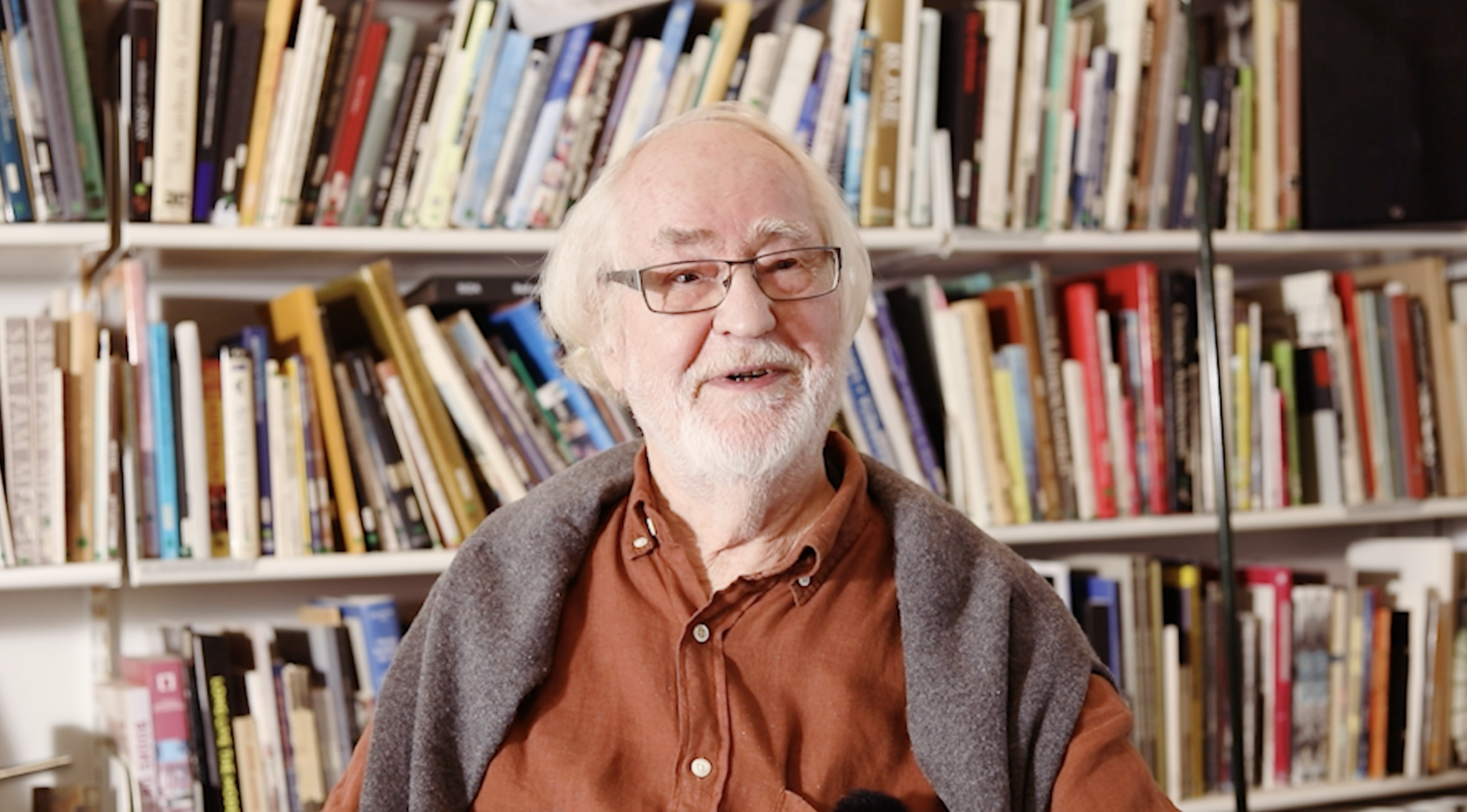
Juhani Uolevi Pallasmaa (born 14 September 1936 in Hämeenlinna, Finland) graduated from Käpylä Co-Educational School in Helsinki in 1957 and earned his degree in architecture from the Helsinki University of Technology in 1966.

Architecture has been only one of Pallasmaa’s many fields of interest. He has remarked that it would be difficult to find another architect whose career has branched out in as many directions as his own. Internationally renowned as an architectural thinker and philosopher of the senses, Pallasmaa is also a prolific writer, critic, educator, exhibition designer and graphic designer whose roots run deep in Finnish cultural life and architectural history.

At the beginning of his career, Pallasmaa worked in the offices of three prominent Finnish architects: Martti Jaatinen, Aulis Blomstedt and Aarno Ruusuvuori. He established his first practice with architect Kirmo Mikkola in 1963. His own office, founded in 1967 and first located on Huvilakatu and later on Tehtaankatu in Helsinki, quickly grew into one of the city’s largest architectural practices of its time.

The office Juutilainen–Kairamo–Mikkola–Pallasmaa is best known for its master plan for the extension of Tapiola town centre (1966–69). When the City of Espoo required buildings of up to eight storeys in the centre, the young architects, who advocated low-rise construction, chose to withdraw from the commission rather than compromise their principles.

Together with Kristian Gullichsen, Pallasmaa designed his first internationally celebrated work, the Moduli 225 Do-It-Yourself Summer House System (1968–72), a landmark of modern architecture. This modular timber building system reflected the spirit of 1960s student radicalism and a desire among young architects to introduce bold innovations in housing.

Other notable projects in Finland include the Boulevard of the Itäkeskus Shopping Centre in Helsinki (1989–91) and the master plan for the Kamppi Shopping Centre and its underground bus terminal (2003–06). His influence is also visible in northern Finland through projects such as the Rovaniemi Art Museum (1984–86), housed in a former postal depot, and the cultural centre Korundi (2009–10). Korundi includes an acoustically acclaimed concert hall designed to evoke the sensation of stepping inside a historic wooden musical instrument.

The award-winning Siida Museum (1998) emerged from eight years of collaboration between the architect, researchers and the Sámi community, including numerous extended visits to Sámi cultural environments.

Museums and exhibitions have played a central role throughout Pallasmaa’s career. His longest professional engagement was with the Museum of Finnish Architecture (now the Architecture & Design Museum), where he worked from 1958 to 1983. Over the years he served as exhibition assistant, exhibition designer, exhibition manager, museum architect and finally museum director from 1978 to 1983. He created numerous innovative exhibitions, including The Language of Wood (1987), Behind the Mask (1990) and Animal Architecture (1995), as well as a travelling exhibition designed to be transported within its own display tubes and shown as far away as Australia.

As an educator, Pallasmaa served as Director of the Institute of Industrial Arts in Helsinki from 1970 to 1972. Together with Tapio Wirkkala, Kaj Franck and Antti Nurmesniemi, he helped transform the institution into what later became the University of Art and Design Helsinki. From 1972 to 1974 he was Associate Professor at Haile Selassie University in Addis Ababa, Ethiopia, and from 1991 to 1997 Professor of Architecture at the Helsinki University of Technology.

He has also held professorships and visiting appointments at Yale University, Washington University in St. Louis and The Catholic University of America in Washington, D.C., among many others. Universities in seven different countries have awarded him honorary doctorates.

A true cosmopolitan, Pallasmaa has travelled extensively as a lecturer and teacher. His architectural work spans countries including Russia, the United States, China and Ethiopia, and he has created architectural exhibitions in more than thirty countries. Based on his own calculations of flight times, he has circled the globe more than 108 times. Outside Finland, his best-known building is the Finnish Institute in Paris (1990). Another notable international work is the entrance plaza of the Cranbrook Academy of Art in Michigan, USA (1994), which functions both as an architectural sculpture and as an astronomical instrument.

While living in Ethiopia, Pallasmaa designed more than a dozen projects for the City of Addis Ababa and local universities. These included a multipurpose hall with murals for the Public Health College of Gondar University (1972–73) and a settlement for 150 families affected by leprosy in Ambo (1973–74). Experiencing a society with fundamentally different values, traditions and ways of life profoundly transformed his worldview.

Pallasmaa’s travels are reflected in his personal library of approximately 12,000 volumes, all collected and carried back from around the world. He often travelled with an empty suitcase that would return filled with books on architecture, visual art, photography, film, philosophy and poetry. His close friend, the sculptor and strongman Kain Tapper, adopted the same habit and frequently travelled with his own oversized book bag.

The library reflects the architect’s exceptionally broad intellectual interests, but it also contains traces of friendships and professional relationships accumulated over a lifetime. Pallasmaa understood early on the importance of networks and communities. His circle of friends has ranged from carpenters and philosophers to artists, poets and psychiatrists. Among his close Finnish friends were artists Kain Tapper, Raimo Utriainen, Tor Arne, Carolus Enckell and Jorma Hautala; designers Tapio Wirkkala, Rut Bryk, Kaj Franck and Antti Nurmesniemi; and writers Bo Carpelan and Pentti Saarikoski.

Within the architectural community, Pallasmaa maintained particularly close friendships with Kirmo Mikkola and Kristian Gullichsen. Together with the Heikkinen–Komonen office, his practice organised annual sporting competitions ranging from football to traditional church-boat rowing. As a student in the 1960s, Pallasmaa was also connected to the circle surrounding Aulis Blomstedt and the journal Le Carré Bleu, which regularly met at the Museum of Finnish Architecture.

Throughout his career, Pallasmaa has often served as a catalyst for communities, initiatives and intellectual exchange. He helped establish workshop spaces for architecture students at the Cable Factory in Helsinki and hosted philosophy teaching sessions in his own office meeting room. His international circle of colleagues and friends has included architects such as Sir Colin St John Wilson, Kenneth Frampton, Glenn Murcutt, William J. R. Curtis, Roland Schweitzer, Tadao Ando, Álvaro Siza, Renzo Piano, Tod Williams and Rick Joy.

Pallasmaa has served on numerous national and international competition juries, including the jury of the Pritzker Architecture Prize from 2008 to 2014. His books continue to be translated into new languages, and he regularly receives invitations relating to lectures, publications, travel and even unconventional design commissions, including work on a fragrance for a New York perfume house.

The architect’s extensive travels, broad network of acquaintances and extraordinary reading have provided a wealth of intellectual influences, enabling significant shifts in both his architecture and his writing. Over the decades, the rationalist approach inspired by his mentor Aulis Blomstedt gradually evolved into an increasingly sensory and spiritual way of thinking. The constructivism of his youth transformed into a phenomenological and experience-based approach to architecture.

Central themes in Pallasmaa’s thought include embodiment, touch, temporality, tradition, imagination and spirituality. He is best known for exploring architecture as a multisensory experience and for warning against reducing the architect’s profession to a purely technical discipline.

The development of Pallasmaa’s ideas can be traced through his remarkable body of writing. Indeed, perhaps his most significant contribution lies in his literary work: he has published more than 100 books and over 1,500 essays and lectures. Among his best-known works are The Eyes of the Skin: Architecture and the Senses (1996), The Thinking Hand (2009), The Embodied Image (2011), Animal Architecture (1995), Encounters 1 and Encounters 2 (2012), Rootedness: Reflections for Young Architects (2024), and Eight Meditations on Architecture (2026), co-authored with Alberto Campo Baeza.

Across this extensive body of work, recurring themes include the body, the sense of touch, memory, time, imagination, tradition and the spiritual dimensions of human experience.

Juha Vehmaanperä

Juha Vehmaanperä is a knitting artist whose work focuses on slow fashion, queer theory and craft-based knowledge. Vehmaanperä’s projects combine traditional handcraft techniques with contemporary approaches and technologies. Community engagement, the promotion of DIY culture and the reinvention of craft traditions are central to the artist’s practice.

Originally from Tampere and now based in Helsinki, Vehmaanperä was born in 1993. They graduated with a Master of Arts degree from Aalto University’s Fashion, Clothing and Textile Design programme in 2022. Vehmaanperä received the Taito Award in late 2025 and was named Young Designer of the Year in 2022.

In addition to the Craft Punk exhibition at the Architecture & Design Museum, Vehmaanperä’s work has been exhibited at the Oulu Museum of Art and Helsinki Art Hall.

Kaj Franck’s Cine Film Footage Offers a Glimpse into the 1950s

Kaj Franck’s cine film archive entered the museum’s collections in 1990 as part of the designer’s bequest. The collection consists of 21 reels of footage shot on Kodachrome film, a format introduced by Kodak in 1932 for amateur filmmakers. In 2011, the material was also deposited in the collections of the National Audiovisual Institute (KAVI).

In 1956, supported by two travel grants, Kaj Franck embarked on an extensive journey that first took him to New York and across the United States, then onward to Mexico, Japan and Thailand. Before setting out, Franck acquired a cine camera and documented what he encountered along the way. A selection of this extensive cine film footage was digitised and presented as part of the Design Museum’s Travel as a Tool exhibition in 2020. The films reveal what attracted the designer’s attention during his travels.

In spring 2020, as part of the Design Museum’s Travel as a Tool exhibition project, ten film reels were digitised and edited into four excerpts of approximately ten minutes each. The digitisation was carried out by Reel One Ltd, and the excerpts were edited by exhibition curator Anna Vihma.

Kaj Franck’s travel films offer unique insights into what caught the designer’s eye, what interested him during his journeys and what he considered worthy of recording on valuable colour film.

Because KAVI’s equipment did not allow the original cine films to be viewed before digitisation, the selection of reels was based largely on Franck’s own notes written on the film cases. The aim was to focus specifically on footage recorded during his travels. The ten reels yielded nearly three hours of digitised material. Part of the footage was filmed in Helsinki, including Suomenlinna, Market Square, Hakaniemi Market Square, carpet-washing piers, and construction sites in Hermanni and Arabia. Most of the material, however, dates from the 1956 journey.

The excerpts published online seek to provide a representative overview of the collection. The four approximately ten-minute compilations include colour footage from New York and Chicago, rural America and coastal towns, as well as Mexico. They also contain material from Franck’s time in Japan and from his travels to Bangkok and villages in Thailand. Emerging repeatedly throughout the films are themes that appear to have fascinated Franck: beautiful rural landscapes, urban vistas, construction sites, everyday objects, scenes of daily life and children at play.

Originally published: 20 November 2020
Text: Curator Anna Vihma and Chief Curator Susanna Thiel

Edited from the original version: 23 April 2026 / Minni Soverila

Textile artist Vuokko Nurmesniemi

The textile artist and designer Vuokko Nurmesniemi (1930-2026) was one of the most significant figures in Finnish design and an internationally recognised pioneer of textile and fashion design.

Nurmesniemi is especially known for her work at Marimekko in the 1950s, where she played a key role in shaping the company’s visual identity during its international breakthrough. Her iconic designs, such as the striped Jokapoika shirt, have become enduring classics of Finnish design.

Born in Helsinki in 1930, Nurmesniemi studied ceramics at the Institute of Industrial Arts (Taideteollinen oppilaitos). Encouraged by Marimekko’s founder Armi Ratia, she moved into fashion and textile design. She began as a printed textile designer at Printex in 1953 and soon transitioned to a clothing designer at Marimekko, where she worked as a designer from 1953 to 1960. Nurmesniemi established her own company, Vuokko Oy, in 1964.

Nurmesniemi’s design philosophy emphasised clarity, functionality, and timelessness. Her work challenged conventions of fashion and contributed to redefining modern clothing for everyday life. Her garments were worn internationally, including by Jacqueline Kennedy, which further increased global interest in Finnish design.

Throughout her long career, Nurmesniemi remained committed to sustainable and enduring design. She received numerous awards and honours, including the title of Academician of Arts in Finland.

Vuokko Nurmesniemi’s life’s work has had a lasting impact on Finnish and international design culture. Her legacy continues through her distinctive body of work and the enduring influence of her ideas.

“There is no fashion, only time.” – Vuokko Nurmesniemi

Design Museum’s Antti + Vuokko Nurmesniemi exhibition, 2022–2023. Vuokko Nurmesniemi, Pyörre fabric, 1964, Vuokko Oy. (Photo: Paavo Lehtonen)

Myllynkivi dress, 1967; Pyörre printed fabric, 1964. Photographed in the atelier home in Kulosaari in 2022. (Photo: Paavo Lehtonen)

Donations to the museum collections since the 1990s

Vuokko Nurmesniemi had a close relationship with the Architecture & Design Museum. Already in the early 1990s, she donated a significant collection of garments and textiles to the museum’s collections.

A major exhibition of Nurmesniemi’s work was held at the Design Museum in 2007. More recently, in 2022–2023, the museum presented the Antti + Vuokko Nurmesniemi exhibition, which highlighted the breadth of the designer’s career and her significance to Finnish design. The exhibition was greatly loved by the audience for its versatile approach.

Main photo: Vuokko Nurmesniemi (Max Petrelius)

Design Museum’s Antti + Vuokko Nurmesniemi exhibition, 2022–2023. Dresses designed by Vuokko Nurmesniemi, Iso-4-Raita fabric, 1973, Vuokko Oy. (Photo: Paavo Lehtonen)

Vuokko Nurmesniemi and the Kakemono printed fabric, 1957. (Antti Nurmesniemi Archive)

From the Design Museum’s Antti + Vuokko Nurmesniemi exhibition, 2022–2023. Jokapoika shirts, 1956, in Piccolo fabric, 1953, Vuokko Nurmesniemi, Marimekko. (Photo: Paavo Lehtonen)

Kaj Franck

Kaj Franck (1911–1989) is one of Finland’s most internationally renowned designers, whose beautifully practical objects continue to inspire new generations of designers. Franck graduated in 1932 as an interior architect from the Central School of Industrial Arts in Helsinki.

During the 1930s and 1940s, he worked in various roles in interior design companies and designed printed textiles, among other things, for the Helsinki Dye Works. In 1948, the Arabia ceramics factory appointed Franck as its artistic director. His best-known tableware designs for Arabia include Kilta (1953) and its successor Teema (1981).

In 1951, Franck became the artistic director of the Nuutajärvi glassworks, and from the mid-1950s onwards glass became his primary material. In the 1960s, he worked as a teacher at the Institute of Industrial Arts in Helsinki, significantly influencing an entire generation of designers. After ending his teaching career, Franck focused on art glass and experimental glassmaking techniques at Nuutajärvi.

The Architecture & Design Museum’s extensive Kaj Franck collection consists of more than 7,000 objects, photographs, and drawings.

Portrait: Kaj Franck 1953, Studio Pietinen