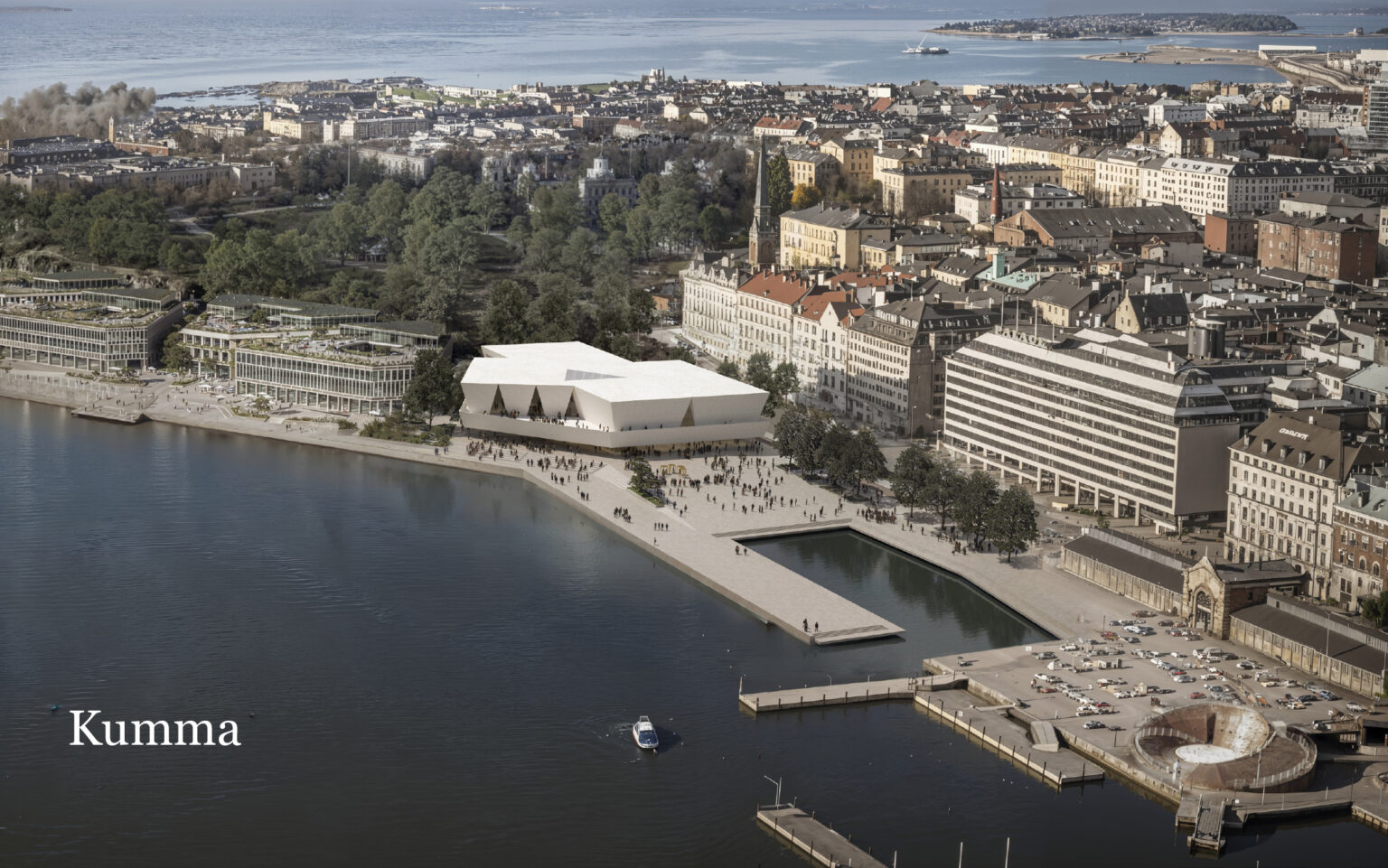
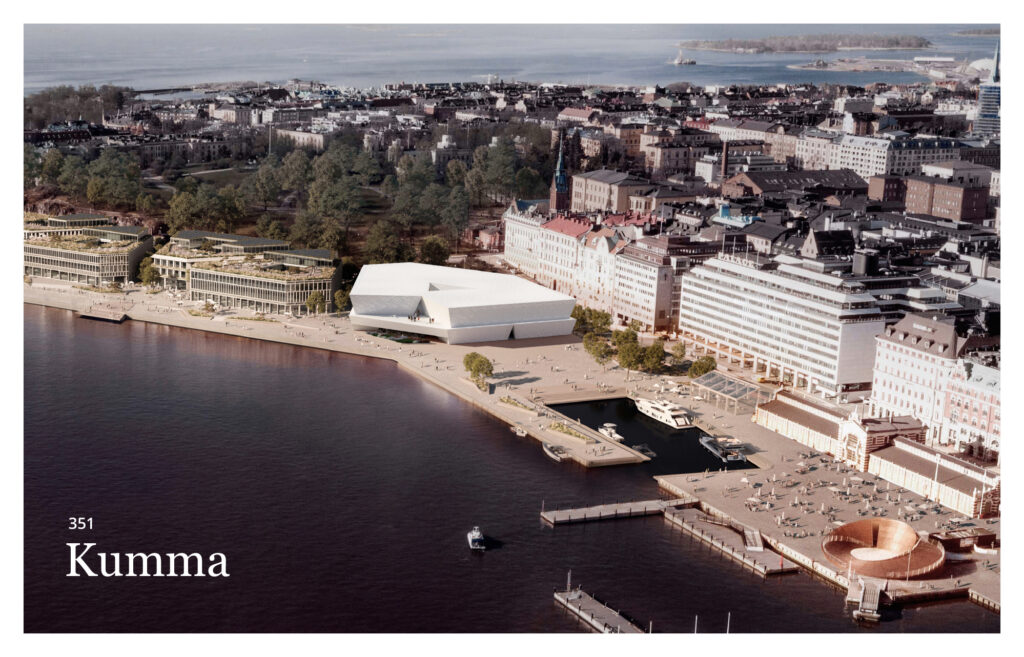
The 18 month-long process of selecting an architect to design Finland’s new Museum of Architecture and Design in Helsinki has completed, with the announcement that JKMM Architects, a Helsinki-based architecture practice, has won the international, open and anonymous design competition for the project. JKMM Architects’ design, known during the competition as Kumma, will create a landmark waterfront museum that will showcase Finland’s unique culture of architecture and design on a global stage.
The international design competition received 624 proposals from around the world. Architects from all countries that are party to the WTO’s Government Procurement Agreement (GPA) were eligible to participate, and most of them were represented. About a fifth of the proposals came from Finland. After Finland, the most represented countries were Italy, the USA, France and the UK.
“The jury made a unanimous decision in the anonymous competition”, says Mikko Aho, Chair of the Jury. “Kumma blends into the cityscape, protecting valuable views of the historic waterfront, while at the same time standing out as a recognizable landmark. The use of recycled brick on the facade brings sculptural, architectural warmth and the terrace surrounding the building strengthens the connection to the city. The winning proposal, which is perceived as monumental and angular, is intended to be developed in a more approachable direction. approachable direction. We and the design team share the view that climate-smart solutions are at the heart of further development.”
“I hope that the planning and realization of the new Museum of Architecture and Design can show the way for how new things can be built responsibly and with skill”, states Samuli Miettinen, founding partner and principal designer at JKMM Architects. “Architecture and design are deeply human – they are born from dreams and longing, and they gain their meaning in the places where we can experience and live together.”
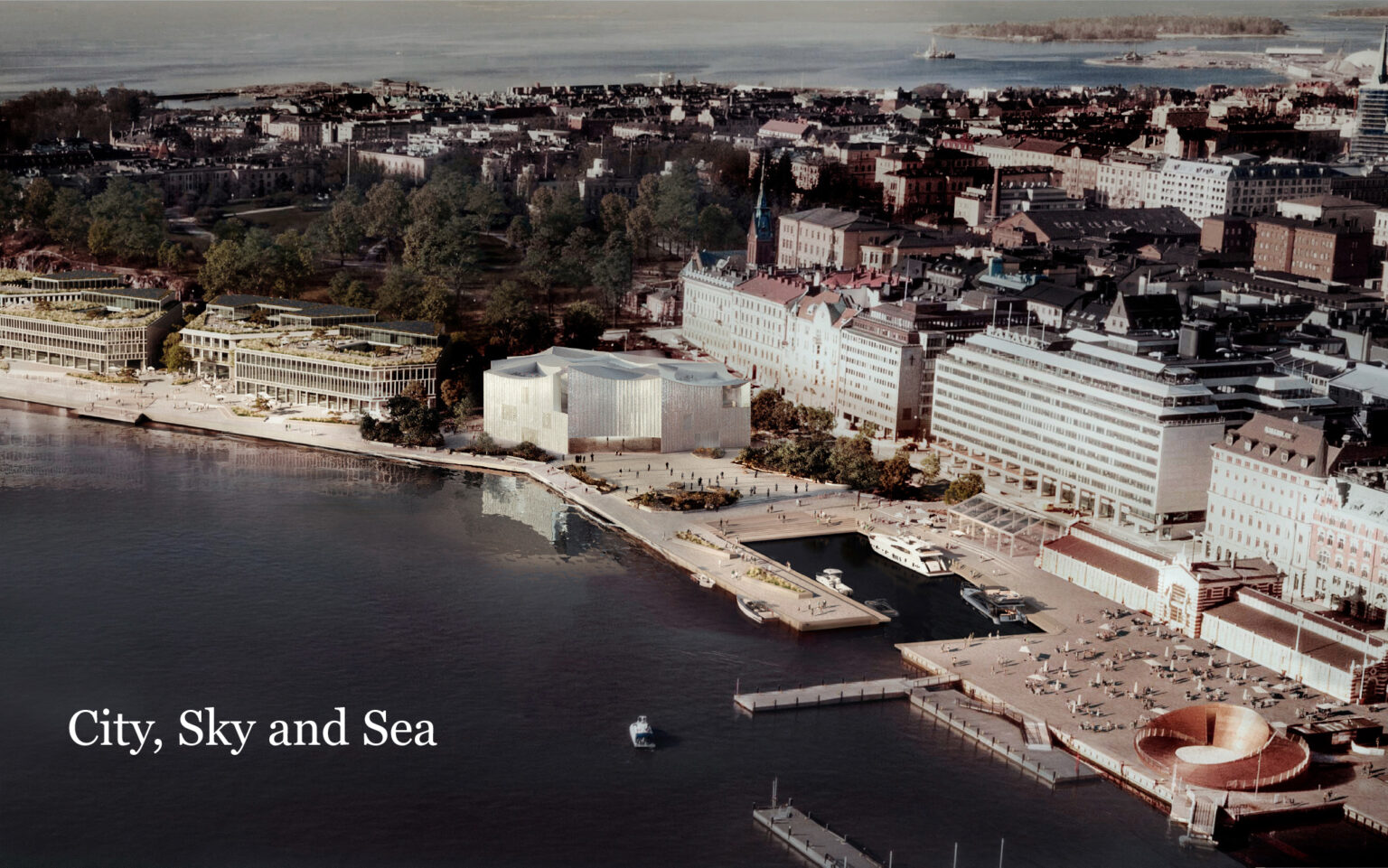
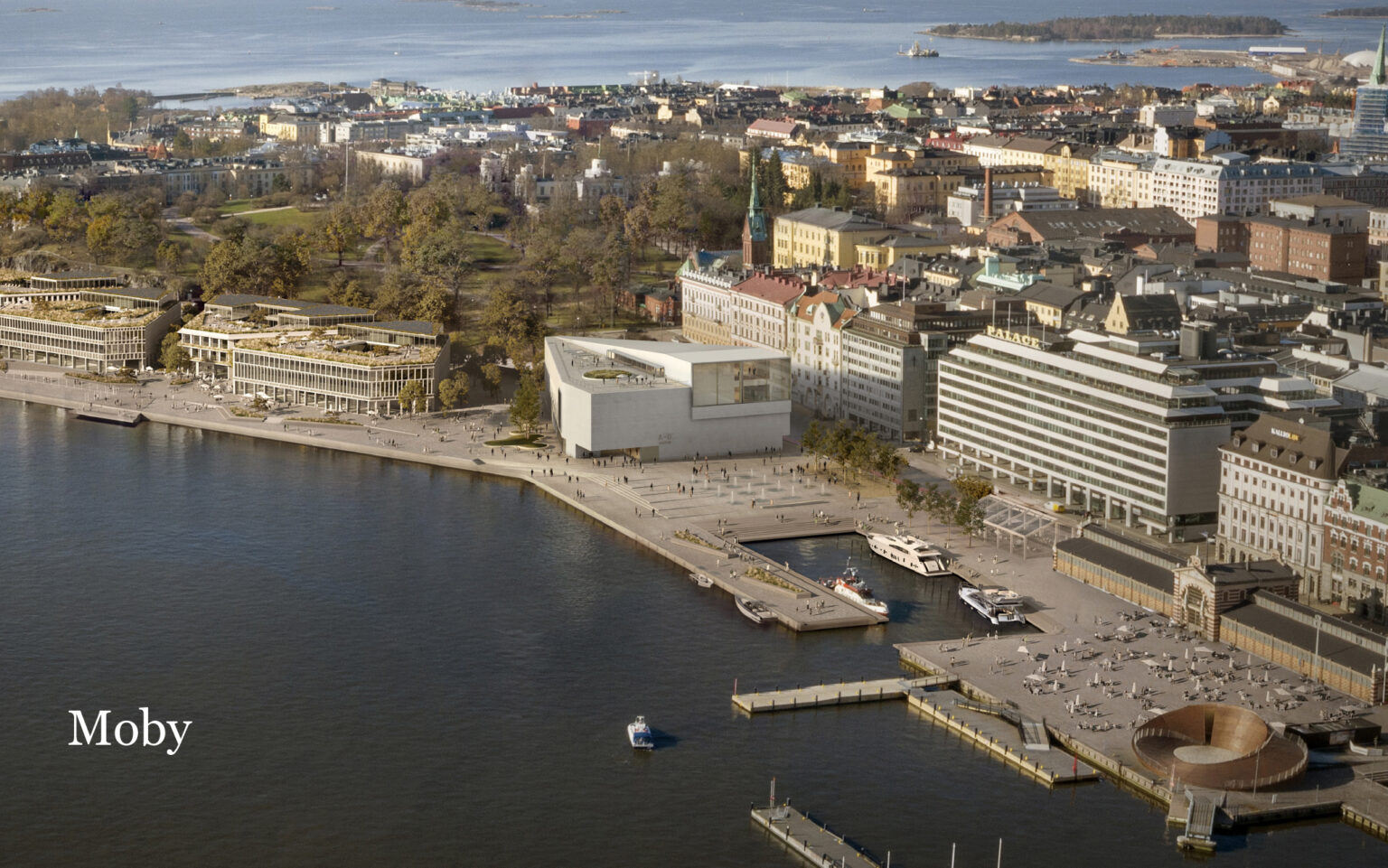
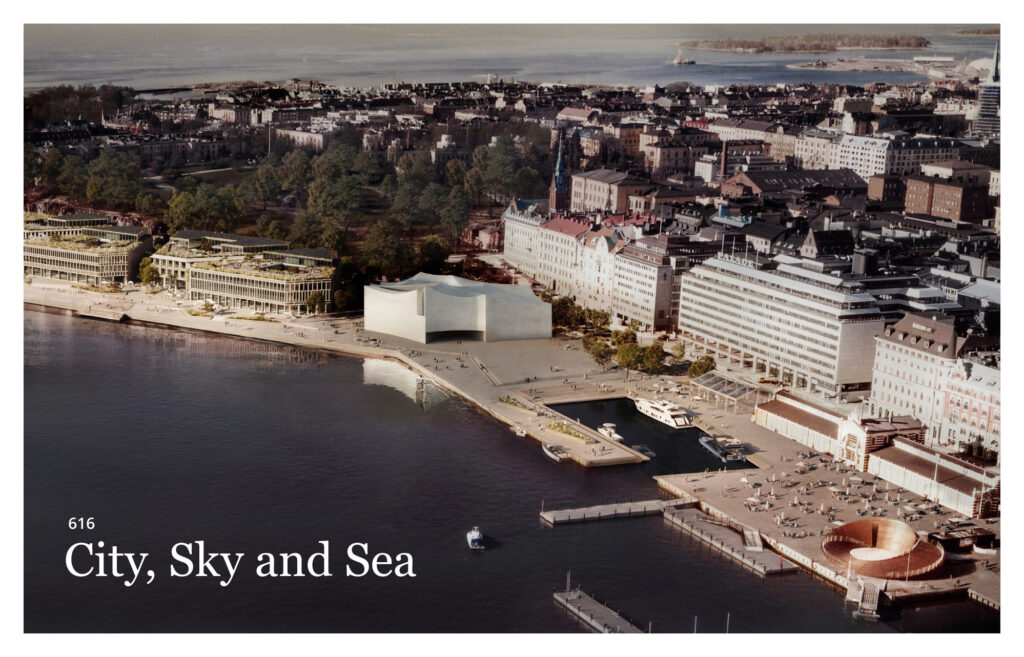
JKMM Architects’ winning design was awarded €60,000 in prize money. A second prize of €35,000 was awarded to the City, Sea and Sky entry by Cossement Cardoso, an architecture office founded by Charles Cossement and Gil Cardoso, based in Portugal and Belgium. Third prize and €25,000 was awarded to Lopes Brenna, an architectural practice based in Chiasso, Switzerland, for its entry, Moby.
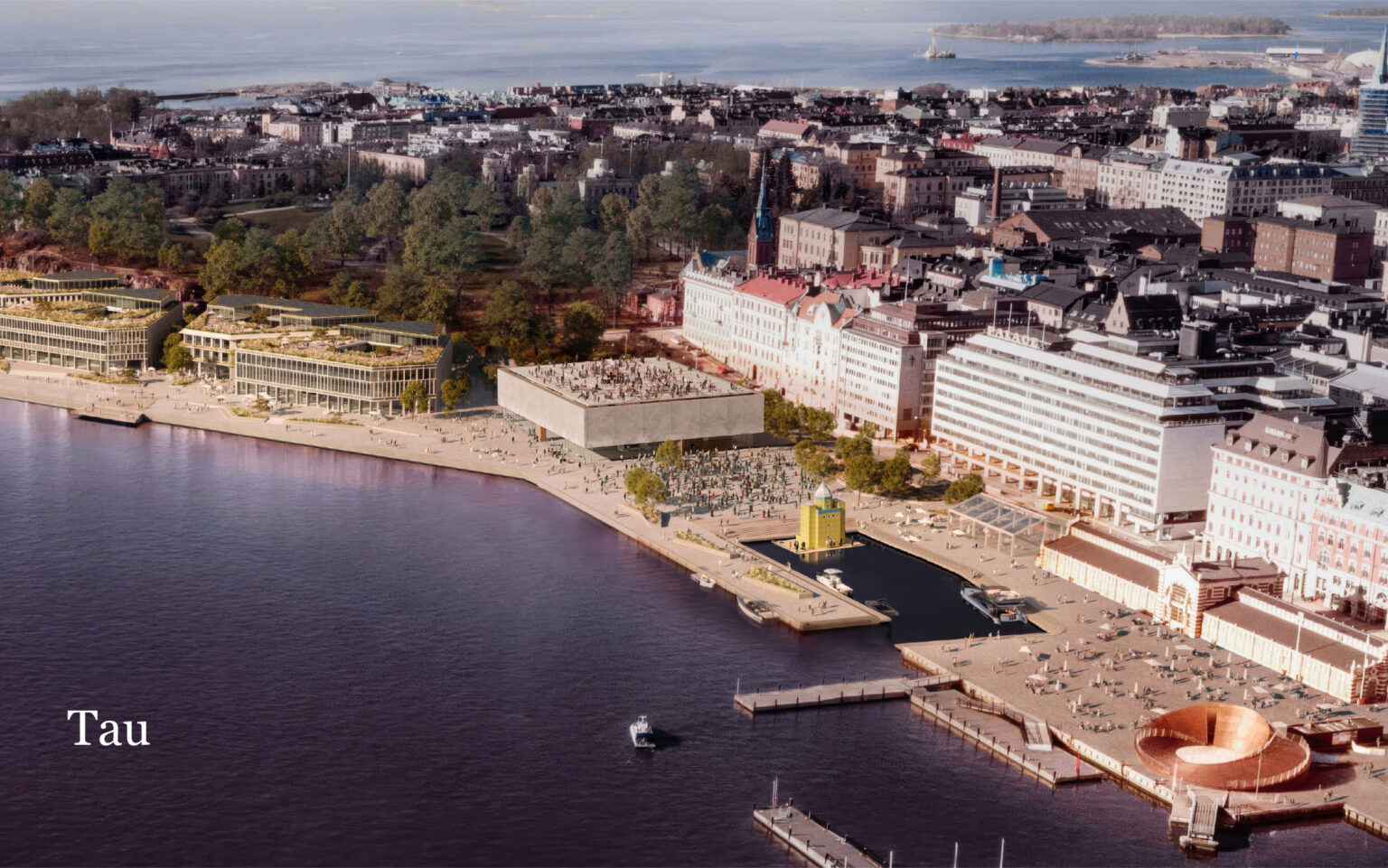
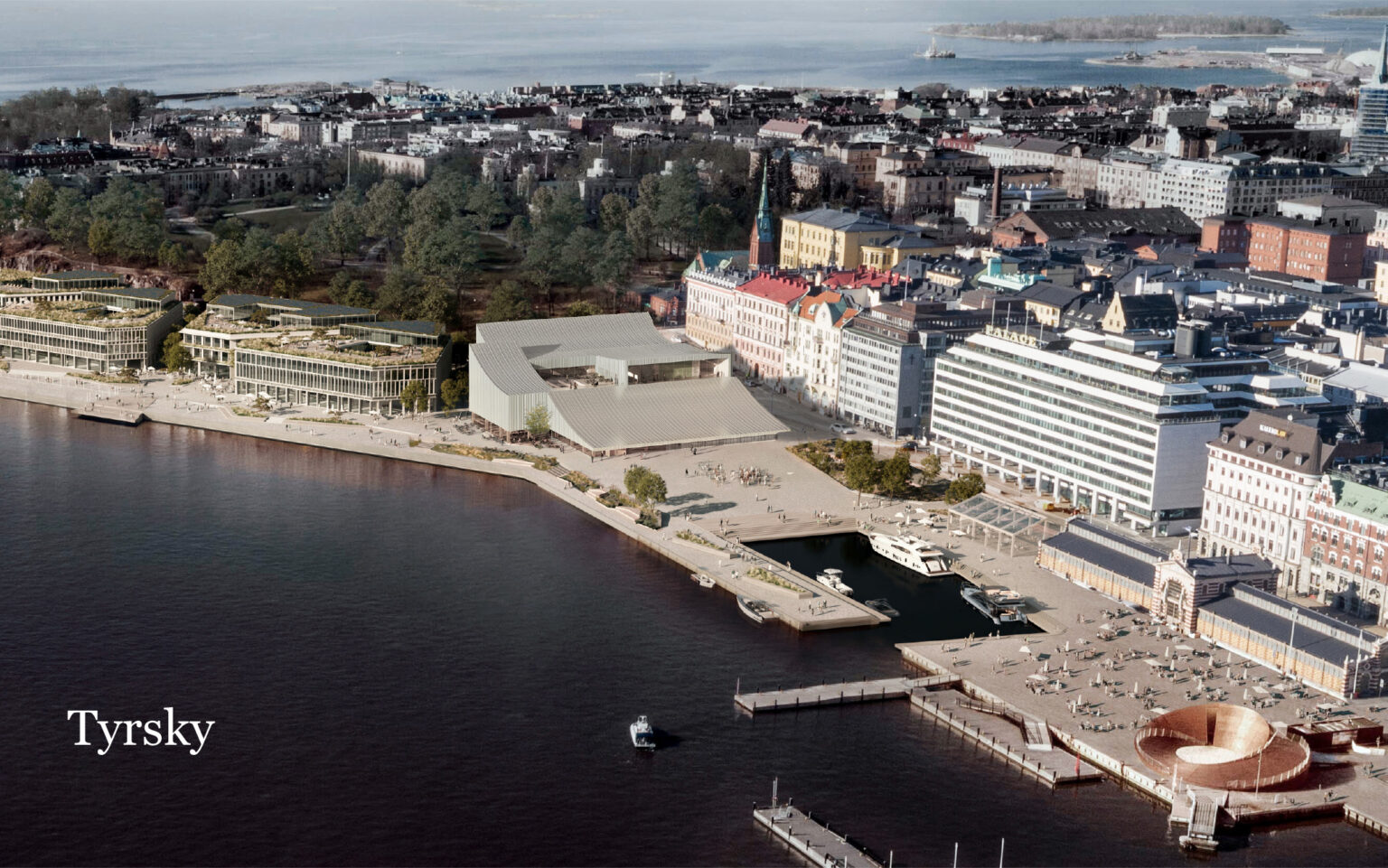
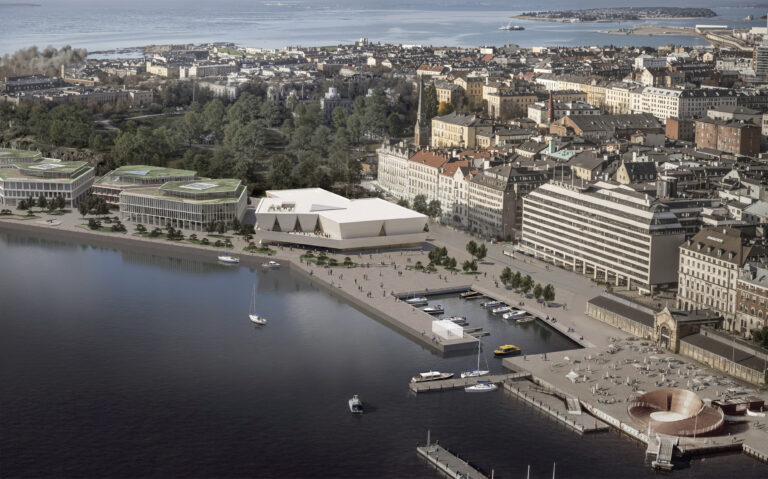
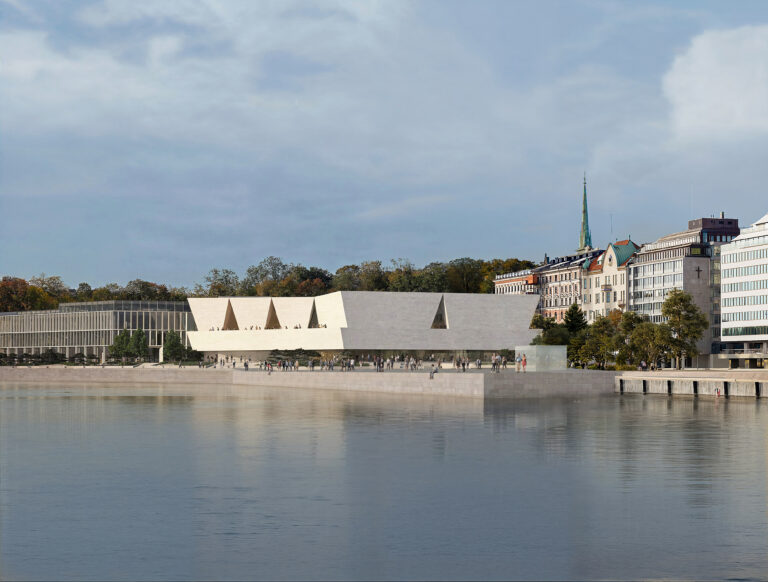
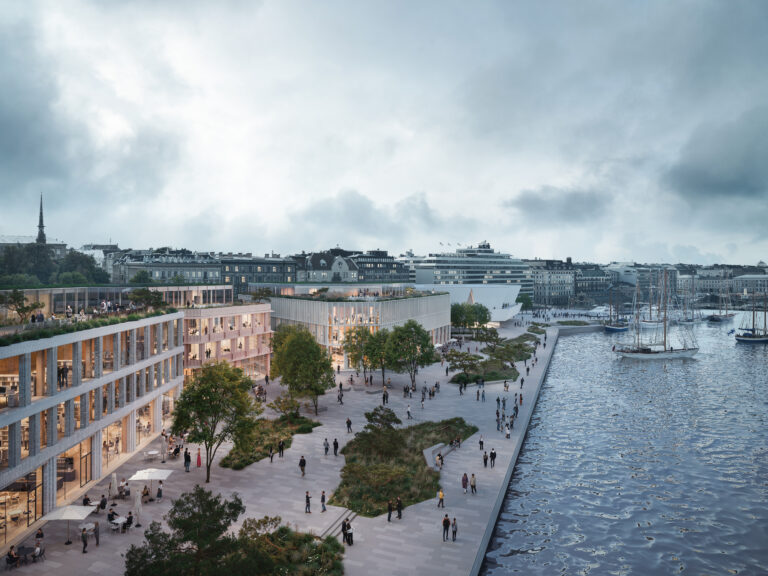
The jury awarded fourth prize and €20,000 to the Tyrsky design completed by a collective of Finnish architects. A purchase option of €10,000 was made to secure the TAU design by the French practice, Atelier Orda.
JKMM Architects
JKMM Architects is one of Finland’s leading architecture practices, responsible for internationally celebrated projects including the Amos Rex art museum in Helsinki, Tammela Stadium in Tampere, University of the Arts Helsinki, Dance House Helsinki and Finland’s contribution to Expo 2020 Dubai. The practice is currently working on an Annexe to the National Museum of Finland, also in Helsinki, due to open in 2027, and an annexe to the Lillehammer Art Museum in Norway. JKMM Architects was founded by Asmo Jaaksi, Teemu Kurkela, Samuli Miettinen and Juha Mäki-Jyllilä in 1998. The practice has twice been a recipient of the Finlandia Prize, the highest annual award for Architecture in Finland.
The international design competition for the new Museum of Architecture and Design in Helsinki will culminate in the announcement of the results.
You are warmly welcome to follow the announcement live on Helsinki channel on Thursday, 11 September, from 10:00 to 11:30. The event will be held in English, and the live stream will include Finnish subtitles.
The two-stage competition has sought a design for a new 10,000 m² museum building in Helsinki’s historic South Harbour. The building is intended to provide a world-class setting for museum activities. The finalists are the entries City, Sky and Sea; Kumma; Moby; Tau; and Tyrsky.
Construction work at the site of Helsinki’s new Museum of Architecture and Design will commence in August with the renovation of the upcoming museum’s building spot, the Makasiini Quay.
At the beginning of August, the City of Helsinki will commence construction work at the area between the Old Market Hall and Olympia terminal which will eventually become the building spot for the new Museum of Architecture and Design. The renovation of the Makasiini Quay will mark the first phase of the Makasiinranta area’s overhaul.
The goal is to turn Makasiininranta into a cozy public space which integrates seamlessly into the city’s seaside trail between Helsinki Market Square and Kaivopuisto. Besides the new building for the Museum of Architecture and Design, the area will see the construction of the Saaret project which consists of four separate buildings with facilities for hotel operations, offices and business spaces.
The winner of the internationally noted design competition for the Museum of Architecture and Design will be revealed on 11 September. The goal is to create a museum of architecture and design that meets international standards while serving as both a travel destination and a national responsibility museum.
Currently, Makasiininranta serves as a traffic terminal area for the harbour and as a parking lot. Its development will be enabled by the decreasing harbour operations within the area. In the future, regular passenger- and ferryboat traffic will be concentrated to West Harbour and Katajanokka. Piers for visiting cruise ships will be left in place at Olympiaranta.
The goal of the renovation project is to reinforce Makasiini Quay’s seawall and stabilise the soil underneath. The Makasiini Quay renovation project will be completed by October 2026. Situated north of Makasiini Quay, the renovation of Pakkahuone Quay is estimated to begin in October 2025 and be finished by spring 2027. According to the preliminary schedule, the preliminary construction of the area and its streets should commence at the beginning of 2027. The construction of the Museum of Architecture and Design and the first phase of the Saaret project will be completed by the early 2030s.
Five developed proposals for Finland’s New Museum of Architecture and Design in Helsinki have been unveiled for a final round of public feedback.
The anonymous proposals have been prepared during the final phase of the international, open, design competition to find a design team for a new 10,050 sq m museum building that will be constructed on the Makasiiniranta waterfront, in Helsinki’s historically significant South Harbour district.
Members of the public can submit comments until 31 July via the City of Helsinki’s Kerrokantasi (Voice your opinion) online platform. A summary of the public input will be compiled and shared with the competition jury before the winner is selected. The result of the competition will be announced on 11 September 2025, after which the design process will continue based on the winning proposal.
The central mission of the new museum will be “democratising the tools of design”, and the competition has been participatory from the outset: museum audiences and professionals from various disciplines have been widely consulted, with their insight shaping both the competition brief and the museum’s conceptual development. During the second stage, proposals have been assessed through a multidisciplinary lens. Beyond architecture and cityscape, the jury has considered perspectives related to urban culture, design education, and how to better serve groups with special needs.
The open phase of the competition was launched in April 2024, attracting 624 submissions from around the world. The five finalists were first announced in December 2024 and are named City, Sky & Sea; Kumma; Moby; Tau; and Tyrsky. The process of developing the proposals began in February 2025, following an opportunity for public feedback, which was communicated to the design teams alongside guidance from the jury and project team.
Kaarina Gould, CEO of the Foundation for the Finnish Museum of Architecture and Design, said:
“The aim of the competition is to design a new museum building in a fair and transparent way. Finland has a strong tradition of anonymous architectural competitions, which allows the jury to focus entirely on the content of the proposals. Within the framework of anonymity, we wanted to give the design teams an opportunity for direct engagement with future museum users through a series of workshops, which we believe have led to stronger proposals. It will be truly exciting to see and hear what the people of Helsinki — and anyone interested in the new museum — think of the final submissions.
“Design and architecture are such fundamental parts of Finnish identity that this competition is about much more than a building. It’s a long-term investment in our cultural heritage and shared future. Even during construction, the project will create jobs and drive economic growth, and once open in 2030, the museum will become a key attraction for Helsinki and Finland”
Mikko Aho, Chair of the competition jury, said:
“During phase 2 of the design competition, the jury gave thorough feedback on each of the five proposals. Our focus was on three priorities: firstly, on developing the functionality of the museum spaces so that they are adaptable for future needs. Secondly on how the building interacts with it’s surroundings, creating an inviting urban environment, and thirdly on setting the right ambition level in creating a climate-resilient building. Our task now is to evaluate how the proposals meet the goals of the competition.”
The new museum of architecture and design in Helsinki will draw on the rich traditions and contemporary strength of design and architecture in Finland and the Nordic region. It will offer engaging programs that reveal the relevance and potential of design in a changing world. The new building will also host high-profile touring exhibitions and offer attractive public services, from a design library to an open-access summer terrace.
The competition brief tasked participants with designing a museum that meets the urban and architectural demands of thishistorically important site, while also delivering on the museum’s goals of being flexible, inclusive, and welcoming.
Sustainability — ecological, social, and cultural — is a key principle guiding both the design and construction of the new museum. Helsinki has committed to becoming carbon neutral by 2030, and the museum project actively supports this goal across its operations.
Proposals
City, Sky and Sea
Due to its curved walls and roof, the new building gives a tent-like impression. The façades of the building consist of cast panels made from recycled glass. The museum has been designed with a large staircase in the central lobby and exhibition spaces around it following the curved forms of the facades. In addition to a translucent glass roof, two terraces have been placed on the roof — one facing the Market Square and the other facing the sea.
Kumma
The new museum building has been designed to be compact and low in height, preserving views from Tähtitorninvuori Park towards the Market Square and Katajanokka. The proposal’s slanted, stepped walls, and the triangular forms of the facade continue into the interior and the main stairs. The exhibition floor overlooks the sea from a large terrace, which continues as a wrap-around outdoor gallery and balcony.
Moby
The new building is designed with a wedge-shaped footprint, leaving space on the side for views from the waterfront towards Tähtitorninvuori Park. The interior of the building offers large views of the surroundings. The façade of the building is made of recycled light-bricks. On the roof is a large terrace with a view of the sea.
Tau
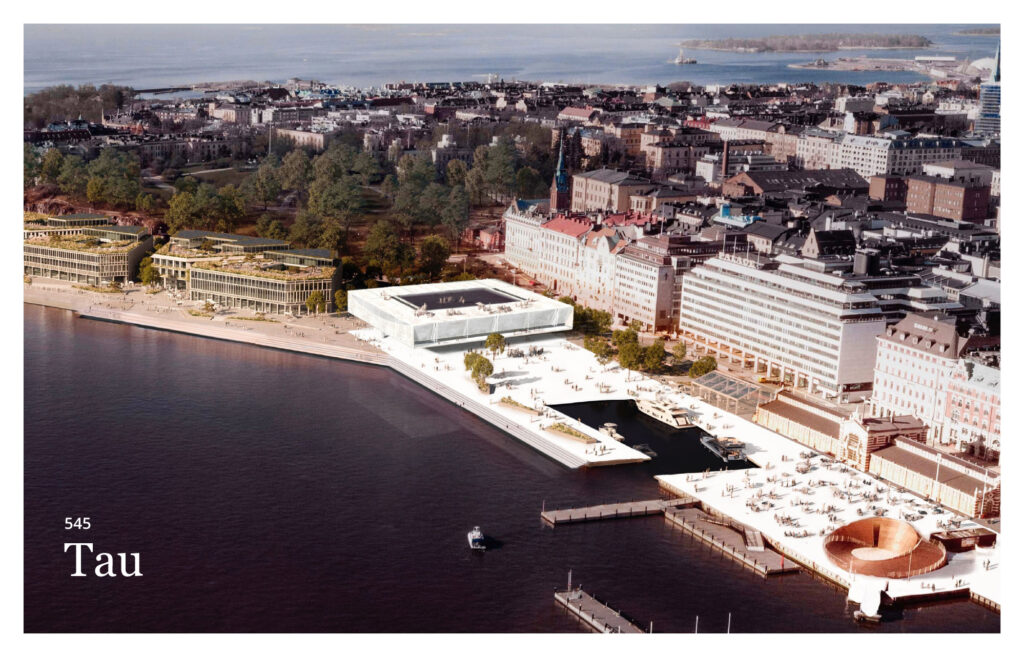
The rectangular building is low in its height and the large glass facades connect the interior of the museum to the building’s surroundings. The building materials are glass, granite and different wood materials such as birch and pine. There is a large terrace on the roof.
Tyrsky
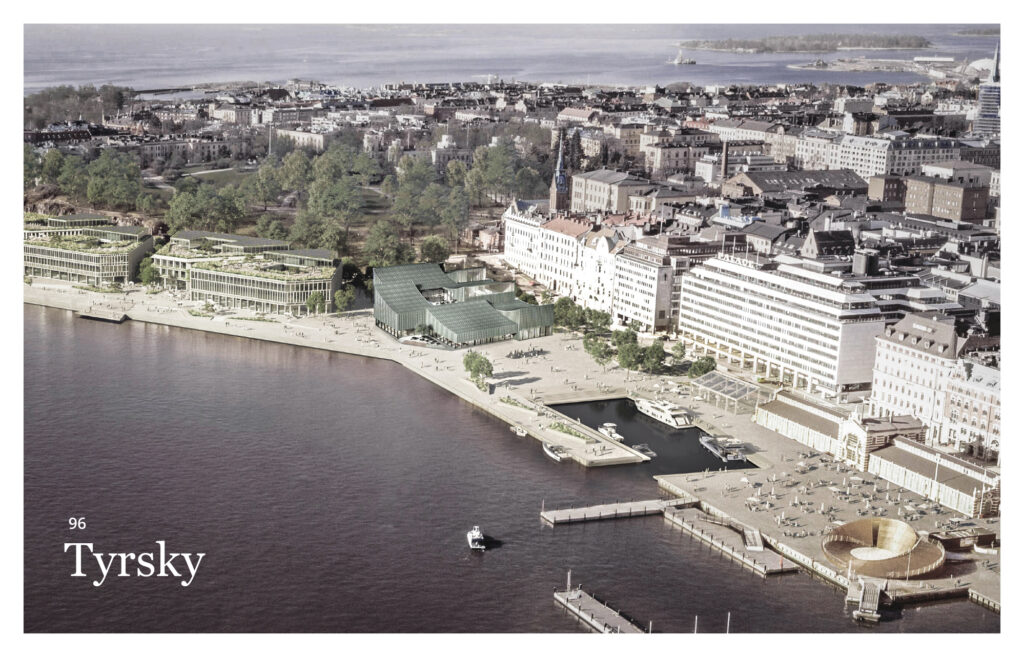
The building, with its curved roof and zinc-sheet cladding consists of rectangular volumes. In the middle of the building, there is a small inner courtyard, which also allows daylight into the centre of the building. The undulating roof draws inspiration from the sea and its rhythms. The proposal uses solid timber for both load-bearing structures and interior surfaces.
The design competition is arranged by the city and state-owned Real Estate Company ADM together with the Foundation for the Finnish Museum of Architecture and Design. The new museum is made possible with funding from the City of Helsinki, State of Finland and generous donations from several private foundations.
In the anonymous design competition for the new Museum of Architecture and Design in Helsinki we used co-creation on an unprecedented scale. We like to think our goal was to make the jury’s work more difficult by making all finalist designs as good as possible.
By Tommi Laitio
Finland lives and breathes design and architecture. The Finnish design tradition is a globally known brand, a source of national pride and one of the main reasons to travel to Finland. So when in 2022, the Government of Finland and the City of Helsinki, together with philanthropic partners, made the decision to establish the Foundation for the Finnish Museum of Architecture and Design with the intention of building a new world-class museum, the expectations could not be higher.
Combining architecture and design into one museum had been decades in the making. In the concept for the new museum, the ambition was nothing short of democratizing the tools of design and architecture, while raising awareness on how design can be used for creating more sustainable futures. The selected plot is part of Helsinki’s iconic skyline with the Presidential Palace, City Hall and the two cathedrals. The €150 million endowment for the museum would be made at a time when most museums, artists and arts institutions were facing austerity measures. Not to mention that this was not any museum but that of design and architecture.
Therefore, getting this right in terms of process and result was critical.
Balancing Anonymity and Engagement
The discussions with the Finnish architect community made it clear that every architect in Finland and beyond would want to win the project. Simultaneously, we knew that both the Association of Architects and the public funders required that the project would follow the 150-year Finnish tradition of anonymous, two-stage competition. In a two-stage competition, the jury chooses the finalists and the competition organization provides them with a development grant for their final submission. The works would compete anonymously, meaning that the jury and the commissioning organization would learn the identities of the designers only after the winner had been chosen. Due to regulations, the competition would need to be EU-wide and a public procurement process.
There’s a lot of reasons to be proud of the competition tradition. Most notable Finnish architects have made their breakthroughs in anonymous competitions. An anonymous competition is what has resulted in many of Finland’s iconic buildings, like Alvar Aalto’s Paimio Sanatorium (1933) and Helsinki’s Central Library Oodi (Ala Architects 2018). Ideally, an anonymous competition removes bias from the competition. The work speaks for itself regardless whether the architect is a seasoned professional or straight out of school.
Simultaneously we were doing something incredibly complicated. The museum building is part of a larger development of the harbour area, which requires immense amounts of coordination. The project’s public funding creates a moral obligation for public engagement and co-creation. Stakeholder engagement is needed to improve the design but also to build advocacy and legitimacy for the project. Also, the museum staff has tremendous and critical expertise, which would be foolish to ignore.
So we needed a competition process that would build on ambitions that first seem to be in direct contradiction: doing things together and doing things anonymously. We needed an innovative way to bring more views and expertise into the process, while securing a firewall between the competition jury and the design teams. Breaks in the firewall could result in lawsuits, delays, decrease in public trust or even an obligation to disquality and redo the entire competition.
Step 1: Supporting the Selection of Finalists
There is a strong precedent and an expectation that the competition needs an approval from the Finnish Association of Architects’s (SAFA) competition committee, which also appoints two members to the jury. After months of negotiation, we agreed on an enhanced version of the traditional two-stage competition.
We knew from recent anonymous and international competitions for Helsinki’s Central Library Oodi (544 entries) and Helsinki’s Guggenheim Museum (1715 entries) that it was likely that the first stage would attract a flood of entries. There was no intentional goal to achieve a record-high number of applications and intentional decisions were made to manage this. The entry was limited to 12 pages, focusing on the building’s concept, exterior and its connection to the cityscape. The competition was limited only to graduated architects.
The expectation of a flood was not misplaced. The competition attracted 624 entries. An online gallery of all the proposals opened to the public during Helsinki Design Week in September 2024.
The jury undertook the extensive labour of reviewing the entries with the first milestop being a semifinalist list: 20-30 works that best met the ambitious demands set in the competition brief.
It is common practice that as the jury moves from semifinalists to finalists, their deliberation is supported with expert reviews by urban planners, structural engineers, and economists.
We wanted to go further.
Considering the ambitions set for the museum experience, we saw it as crucial that expertise on museum operations and urban culture would be elevated to the same level of importance as knowledge in financial planning, structural engineering or architecture. We recruited a group of internationally recognized urban culture and museum experts not affiliated with the competition organization. Their task was similar to that of engineers, architects and urban planners: to give detailed feedback based on their fields of expertise, such as exhibition design, museum logistics, city events, food and beverage, and customer experience. They commented on things such as how well the technical spaces functioned for moving large objects, the feasibility of audiovisual experiences inside and and on the museum, how the workshop spaces would function for children and how well the design demonstrated an understanding of the critical role of the library and resource center for research. As the independent facilitator for the entire engagement process, I then summarized this feedback into short briefs for the jury.
The jury announced the five finalists on December 18th, 2024. Upon agreeing to the terms of the second phase of the competition, such as adding various technical expertise to the design teams, each of the finalists received 50,000 euros to develop their final submission.
The five first pages of each of the finalist entries were published on the City of Helsinki’s engagement platform for review and commentary. The discussion online was lively, critical and demonstrated a high level of understanding of architecture. Many of the comments focused on criticizing individual entries or calling for “wow” architecture. Reading some of the comments raised questions whether the online platform might have also functioned as a channel for anger and frustration for those architects and other design professionals who had put hundreds and hundreds of hours into their submission only to receive a negative decision. Looking back, there could have been a clearer communication effort from the competition organization to explain that the winning museum would not be selected based on the current material but now the teams would have months to develop or even radically change their entry based on the feedback they received from the jury.
Normally the teams develop their proposal based on written feedback from the jury. Again, we wanted to go further. We decided to do something that had never been done at this scale in Finland: to provide expert consultation on the functionality and experience to all the finalist teams.
Step 2: Expert Feedback
In January 2025, four expert groups reviewed the finalist designs and provided feedback on each of them. The identities of the designers were not disclosed to these experts. The four groups of experts were selected based on the museum’s concept and they were:
the museums’ staff
teachers and other educators
urban culture professionals such as police, skateboarders, youth work event organizers, and tourism experts
accessibility experts
All of the experts had the same assignment: review the works individually and participate in a four-hour workshop in Helsinki. In the workshop, each entry received the same amount of time for review. As the independent facilitator for the entire process, it was my responsibility to ensure that each entry was treated fairly and to capture the feedback and suggestions into a report. Next to these stakeholder workshops, we also gathered feedback from technical and structural experts.
We designed the process with great respect for the mastery and craft of architects. The goal was not to redesign the entries but to support the design intent and provide practical feedback on functionality and experience. Rather than ranking or comparing the entries, we started fresh with each entry. In our preparatory sessions, I described our ambition as making the jury’s work more difficult by supporting all of the five finalist designs to be as good as possible.
Unlike engineers or architects, most of the people we invited do not work with floor plans or circulation diagrams on a daily basis. During our planning phase, we regularly faced doubt and skepticism whether these professionals would be able to be objective. Looking back, I am glad we stood our ground.
While a teacher or a skateboarder does not work with CAD images, they do know a lot about needs and spaces. From our first preparatory sessions to the actual review workshops, we received regular affirmation that we have made the right decision. These professionals showed up prepared, in time and with a clear sense of respect and integrity. One of the early educators verbalized something we witnessed in all the workshops: the power of recognition. She said:”I feel really honoured that we and our kids are recognized as important like this. That our experience is brought in at this stage and not only when we need to fix something that really does not work.”
Even when I have done most of my career in public spaces, I learned so much from these professionals.We discussed issues like the need for calming spaces for visitors on the spectrum or for a toddler having a hissy fit. An educator explained how easy access to restrooms from children’s workshop spaces defines the adult-to-child ratio in the group and therefore the cost of the visit. We learned how the museum’s library goes far beyond books to drawings and models and how designers or researchers often spend days or weeks working on a particular material. We talked about how in this museum an exhibition can consist of valuable items in vitrines but it can also be a noisy and messy process or a big machine. We discussed how the museum’s business model depends on event spaces that provide spectacular city views and can be used outside the opening hours. Something that really stuck with me was an educator who explained how a view, a wall, an elevator or a door, actually the entire museum building, is a pedagogical object beyond the exhibitions. Another note that will stay with me forever was the emphasis of an accessibility advocate on how important it is that people with special needs can move through the museum with their company rather than being sent around the corner for an elevator.
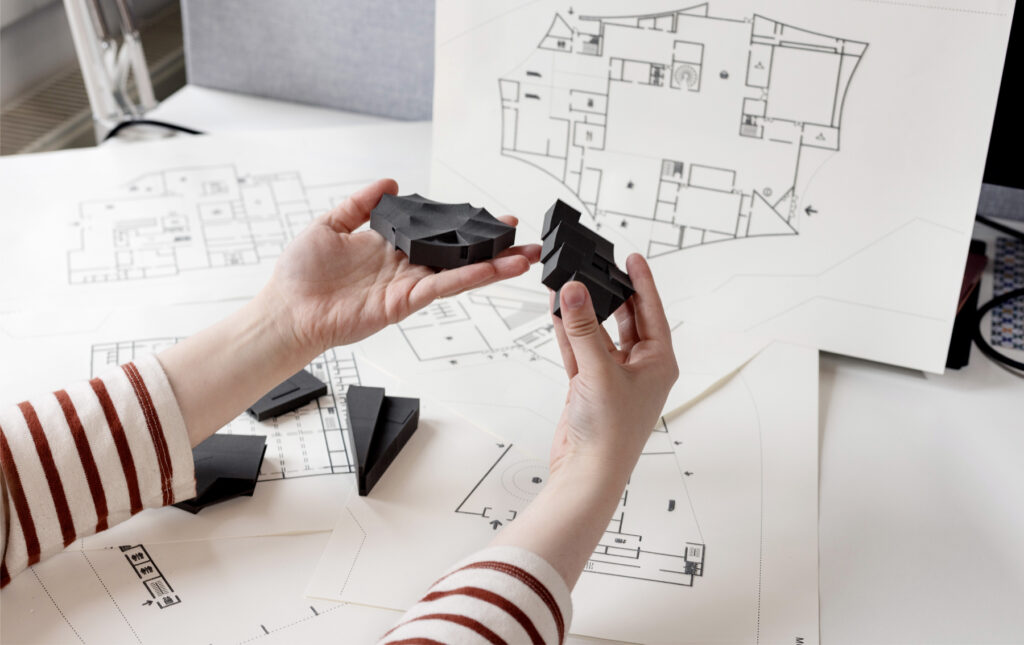
As a result of this engagement, we as the competition organization and I as the facilitator, improved our capacity for inclusive engagement. We learned how to use Braille printers for floor plans, how tiny 3D-prints helped blind experts but were actually beneficial for everyone.
After the workshops, we packaged the feedback with Project Manager Reetta Turtiainen and Competition Secretary Jussi Vuori. This feedback was integrated into reports with the standard technical feedback, structural feedback, and financial analysis. Each team received an extensive package of general feedback as well as detailed feedback on their submission. The level and amount of detailed feedback was way beyond a standard competition.
Step 3: Expert Workshops in Helsinki
As the second round of consultation, each team was given an opportunity to see the building site in Helsinki and receive three hours of in-person consultation from recognized experts in themes like museum pedagogy, exhibition design, food and beverage, public-private partnerships, museum operations, curation, audiovisual design and events. While a substantial financial investment, we saw this as a way to increase the quality of final submissions and an equity investment in an international competition. We designed the process with the assumption that at least some of the teams would be from abroad and many of them might not have had the time, money or means to come to Helsinki in the first stage of the competition.
Each workshop followed an identical format.
Presentation of the entry and first reflections on the jury’s feedback (20’)
Expert conversation on the strengths and challenges of the entry with no interjection from the design team (30’)
Break (15’)
Dialogue between the design team and the experts, focused on the issues the design team wished to discuss (90’)
Visit to the museum site
When designing this process, we took the questions of anonymity and confidentiality very seriously. All of the experts received training on the importance of confidentiality and signed non-disclosure agreements and received training on the importance of confidentiality. We made it clear in the adcance communication and in the beginning of the workshop that the experts were familiar with the competition program but were not representatives of the jury and would have no say in choosing the winner. The design teams received a stipend for travel but arranged their own travel and accommodation. The jury was not informed of the place and time of the workshops. The experts, myself included, only learned the identities of the designers as we shook hands on the morning of the workshop to prevent curious googling or other information gathering. As the facilitator, I emphasized that the teams has responsibility to make sure that they used the experts in a way that benefited their process and that they had full discretion on how and how much of the feedback they would eventually incorporate into their design. As a way to promote anonymity, we did not do written documentation of the workshops and nothing of the discussion was reported to the jury.
Highly Positive and Beneficial Experience
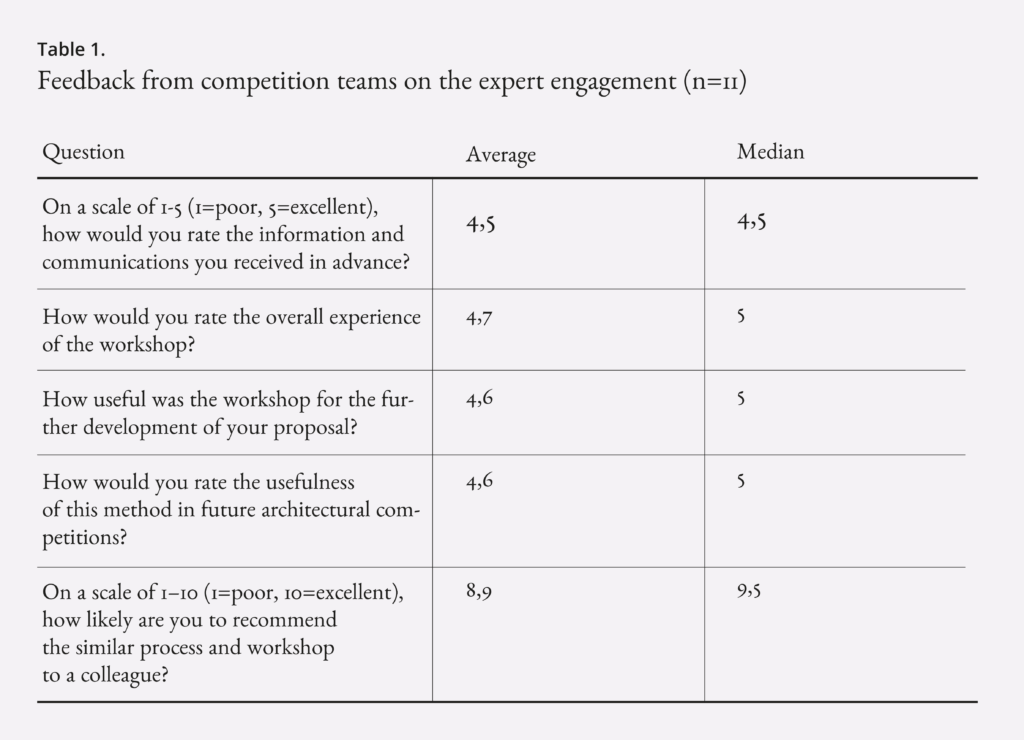
We were doing many things differently and faced concerns and critique along the way. Therefore, we wanted to learn from the process. The anonymous feedback gathered after the workshops demonstrated that we are on the right track. On a scale of one to five, the workshop experience received an 4,7/5 average and a 5/5 median score. The usefulness of the workshops for them now and for future competitions received an 4,6/5 average and a 5/5 median score. A clear majority of the architects would recommend using such a format in future competitions.
The most rewarding feedback was the acknowledgement of valuable expertise beyond tradition. One of the lead architects wrote that they felt that the experts were able to make valuable contributions without disrupting the project. The architect felt that the experts were trying to go along with the concept behind the project as much as possible. Another architect said that the reactions from the experts were valuable and strengthened their own presumptions and that they received valuable ideas and inspiration for further development. Several of the designers appreciated the level of preparation that the experts had done to understand their specific design.
Broadening the Circle of Expertise
The feedback also demonstrates that many of the finalists, like us, see great value in the tradition of an anonymous competition. While the usefulness of the engagement was ranked high, some did raise concerns about ensuring the anonymity of the process. As one of the designers said, “If anonymity can be secured, then this is quite an efficient system.”
We take this concern seriously and took conscious choices to secure anonymity. Simultaneously, it is worth noting that already in the traditional competitions we have had urban planners, structural engineers, and financial analysts reviewing the designs or even meet with the teams in the final stages of the competition. Broadening the circle of expertise beyond finances, design and engineering demonstrates respect and builds legitimacy. Broadening the circle of valuable expertise sends an important message to disability advocates, curators, skateboarders, restaurateurs, the police, researchers, teachers, and arts educators that we need them and their expertise to create thriving public spacesis critical in creating a great museum. Our experience confirms our assumption that a teacher, an conference planner or a disability advocate can provide the same level of integrity, confidentiality, expertise and unbiased review as an engineer.
New Standard for Innovative Procurement
I spent a decade as an executive for the City of Helsinki, in charge of large capital investment decisions for instance for libraries, museums, recreation centers and libraries. Looking back, I would have loved this as a standard for procurement.
What proved to be critical was how the role of the experts was framed. They approached the designs with respect and saw their contributions as consultation rather than critique or ranking.Those who met the teams had an arm’s length distance to the commissioning organization. As a sign of success, most of the experts could see the opportunities in all of the finalists.
The benefits are clear for the commissioning organization. This kind of engagement can help the design teams avoid mistakes that would work against an otherwise stellar concept. As a simple example, If you do not work with museums or children every day, you probably won’t think about where to put 50 rucksacks when a group of enthusiastic and maybe soaked kindergarteners enter a museum but not solving that might destroy your lobby experience completely.
The competition was a public procurement process. Procurement is a field in urgent need of innovation. Our experiment shows that we can find a balance between anonymity and engagement with careful design. Engagement practices can save us from a lot of frustration and conflict later in the process. Fixing something like the location of the service lift or the access to the toilets from workshop spaces is a lot cheaper and easier at this stage of the competition.
What´s Next?
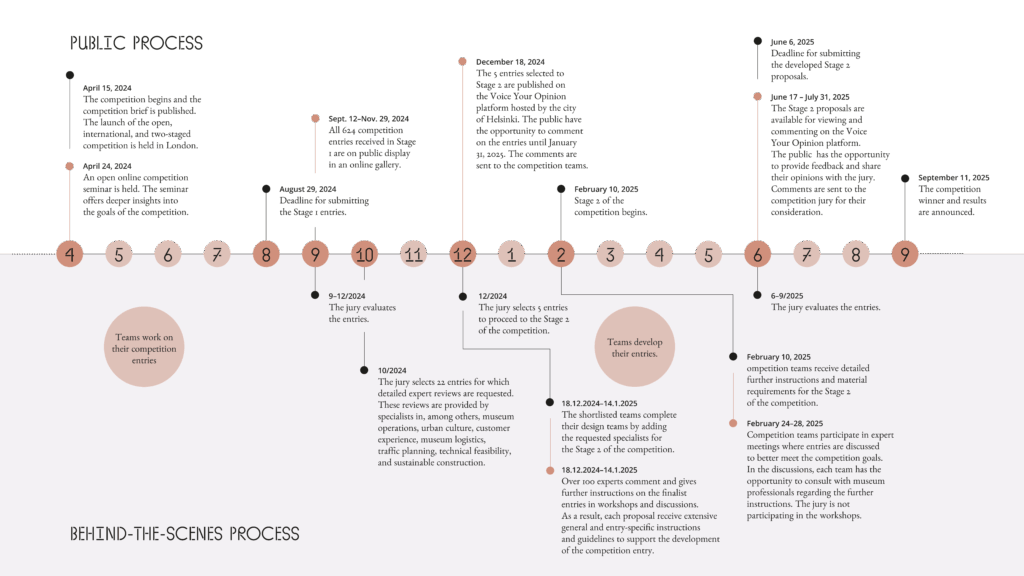
The competition teams have until the 6th of June to submit their final submissions. On June 17, the developed entries will be published for public comments in Voice Your Opinion platform hosted by the city of Helsinki. The winner will be announced in September 2025.
The announcement of the winner kicks off a new stage in co-creation and engagement. As a major investment for the city and the country, the engagement will be essential for the legitimacy of the project. It will pose a test to the winning architects to navigate the often contradictory hopes and dreams of thousands of stakeholders and the public, the budget and structural limitations of the project while holding onto their original architectural concept. The current practices of an anonymous architectural competition do not take the designers´ capability and willingness for collaboration and co-creation into account.
I hope that such stakeholder engagement and co-design will become the norm in a few years in the development for major buildings. The engagement in Helsinki´s Central Library Oodi is earlier proof that a deep understanding of needs and collaboration can create conditions for world-class results. When done well, engagement improves the likelihood of innovation and legitimacy. And what organisation would be better in charting new standards for design than a Museum of Architecture and Design?
Tommi Laitio is an internationally recognized leader and strategist on public spaces, engagement and innovation. Laitio designed and facilitated the engagement in the design competition with the competition organization. Laitio’s practice builds on his experience as City of Helsinki’s first Executive Director for Culture and Leisure (2017-2021) and his research on partnerships and engagement as the inaugural Bloomberg Public Innovation Fellow at Johns Hopkins University (2022-2024). www.tommilaitio.com
The board of the Foundation for the Finnish Museum of Architecture and Design has been strengthened with two new board members. Merja Ylä-Anttila, CEO of the Finnish Broadcasting Company (YLE), and Jannica Fagerholm, Managing Director of the Signe and Ane Gyllenberg Foundation, joined the board overseeing the establishment of the new national architecture and design museum on April 23, 2025.
Merja Ylä-Anttila, who has led YLE since 2018, is a seasoned journalist with a career spanning several decades. Prior to joining Yle, she held various leadership roles at MTV3, where she began working in 1984. Ylä-Anttila studied communications, political science, and political history at the University of Helsinki. She also serves on the council of the Savonlinna Opera Festival, the board of Yle’s Pension Foundation, and is a member of Finland’s National Emergency Supply Council.
Merja Ylä-Anttila / Kuva: Johanna Kannasmaa, Yleisradio
Jannica Fagerholm, M.Sc. (Econ.), is the Managing Director of the Signe and Ane Gyllenberg Foundation, which supports medical research and operates the Villa Gyllenberg art museum. Fagerholm serves on the boards of Kesko, Mandatum, and Solidium, and was recently appointed to the board of Sanoma. In addition, she sits on the board of the Association of Finnish Art Foundations. In the latest Talouselämä listing of Finland’s 100 most influential women in decision-making, Fagerholm ranked seventh.
Jannica Fagerholm / Kuva: Tomi Parkkonen
Timo Laitinen continues as Chair of the Foundation’s Board, with Anne Korkiakoski serving as Vice Chair. Stefan Björkman and Juha Lemström have stepped down from the board. The Foundation for the Finnish Museum of Architecture and Design was established in spring 2022 by the Finnish State and the City of Helsinki. Its mission is to promote and support museum activities related to architecture and design, as well as to advance, support, and raise awareness of these fields more broadly.
The foundation aims to create a new, internationally significant museum of architecture and design in Helsinki’s South Harbour district. It is responsible for the museum’s fundraising and financial management. The Architecture Museum and the Design Museum, along with their collections, were merged into the foundation on January 1, 2024.
Current members of the Board of the Foundation for the Finnish Museum of Architecture and Design:
Mikko Aho, Architect Jannica Fagerholm, Managing Director, Signe and Ane Gyllenberg Foundation Pauli Kariniemi, Director General, Ministry of Finance Anne Korkiakoski, Professional Board Member Timo Laitinen, LL.M. Susanna Pettersson, CEO, Finnish Cultural Foundation Anna Valtonen, Rector, Konstfack – University of Arts, Crafts and Design (Sweden) Merja Ylä-Anttila, CEO, Finnish Broadcasting Company (Yle)
Five Designs Shortlisted for Finland’s New Museum of Architecture and Design in Helsinki
Five designs have been shortlisted in the international open competition to create a home for Finland’s new national museum of architecture and design. The museum is planned for a prominent and historic site in Helsinki’s South Harbour. You can discuss the proposals on the “Kerro kantasi” platform until January 31, 2025.
The shortlisted projects have been selected from 624 responses to an open call for entries, which asked for conceptual proposals for a new 10,050 sq m (GFA) museum building on a prominent and historic site in Helsinki’s South Harbour. All entries were submitted anonymously and were displayed on a public website September–November 2024.
The shortlisted competition entries are:
096 Tyrsky
351 Kumma
486 Moby
545 Tau
616 City, Sky and Sea
Kaarina Gould, CEO of the Finnish Architecture and Design Museum Foundation and member of the jury, said: “We are immensely grateful for the response to our international design competition and want to thank each of the 624 teams that answered our call and submitted their ideas for a new museum building on our extraordinary site in Helsinki’s South Harbour. Reducing the list to just five entries has been a challenging yet inspiring exercise in identifying the greatest potential amongst hundreds of interesting approaches. A massive thank you also to fellow jury members for their commitment – the work continues.”
Gus Casely-Hayford, jury panel member and Director of V&A East, said: “The new museum represents a generational opportunity for the architecture and design sector in Finland, and it arrives at what feels like a moment of wider intellectual and cultural reckoning. The requirements, the need, the opportunities are profound, and enormously exciting. The jury leant into the challenge, interrogating the vast body of proposals to identify this truly exceptional shortlist. These are intriguing projects that feel both timely and timeless, a shortlist of buildings that I hope Finland will be beguiled by.”
Beate Hølmebakk, jury panel member, architect, professor and partner at Manthey Kula in Oslo said: “The five finalist projects represent different visions for an inviting and inspirational museum situated on one of Helsinki’s most important sites. What these entries share is their potential to be buildings of extraordinary and lasting architectural quality. It is the jury’s opinion that they all have distinct urban presence and exceptional spatial properties that allow the new museum of architecture and design to organize the rich variety of exhibitions and events their ambition calls for. In the next phase these projects will be further developed to meet the demands for a sustainable future.”
The poposals will go through further development
The proposals that have advanced to stage 2 of the competition will go through further development. The shortlisted design teams develop their proposals into viable concepts for a new museum building based on feedback from the jury and experts.
Special attention will be paid to the low-carbon nature of the buildings and the use of circular economy, for example through carbon footprint calculations. To better cultivate the usability of the buildings, a series of workshops will be arranged with the design teams and representatives of various user groups, facilitated by Tommi Laitio, a Los Angeles based expert on public innovation.
The public also has a possibility to comment on the proposals until January 31, 2025 at https://kerrokantasi.hel.fi/ad-museo. A summary of the public discussion will be handed to the competition design teams to support the development of their proposal.
Only main visuals and concepts of the shortlisted proposals are made available for public display. The jury has had access to more extensive material, including floor plans, site plans, and other documents requested in the competition brief.
Stage 2 of the competition will open in February 2025 and run until the end of May 2025. The final result of the competition will be announced in September 2025.
Each team selected for Stage 2 will receive a payment of €50,000 in two instalments: €30,000 at the beginning of Stage 2 and €20,000 on completion. At the end of the competition the Jury will award prizes of €50,000, €35,000 and €25,000 for first, second and third place, with purchase options of €20,000 for the remaining two designs.
96 Tyrsky
The curved-roofed building, clad entirely in green copper, blends seamlessly into the waterfront landscape and respects the existing surroundings with its moderate height. The structure consists of several rectangular interlocking volumes, creating a small inner courtyard that allows daylight to reach the center of the building. The undulating curved roof signifies that this is a public building, distinct from the neighboring blocks. The proposal is an excellent example of the use of mass timber in load-bearing structures and interior finishes.
351 Kumma
The new museum building has been designed as a compact and low structure, preserving important views from Tähtitorninvuori Park towards the Market Square and Katajanokka. Despite its low height, the building has a strong character. It is beautifully proportioned, with slanted, stepped walls and triangular openings that reference timeless historical themes. Unlike the other proposals, the building can be accessed from both the Market Square and Laivasillankatu sides, allowing visitors to enter directly into the ground-floor exhibition space.
486 Moby
The proposal takes an exceptional stance on views from the site and the museum’s role as a public building alongside the blocks planned for Makasiiniranta. The new building has a wedge-shaped footprint, leaving space on the side for views from the waterfront toward Tähtitorninvuori Park. The movement of museum visitors between spaces has been carefully designed, and the views opening in different directions from the building have been thoughtfully considered. Thanks to its compact form, logical structural system, and use of recycled materials, the building is resource-efficient.
545 Tau
The building is sculptural in its extreme simplicity. It demonstrates that to stand out from the surrounding urban fabric a landmark status can be achieved without relying on unconventional shapes, or distinctive materials. The design emphasizes the role of the new museum as an extension of the Market Square, welcoming visitor flows along its entire northern façade, which connects seamlessly to the water mirror of the Vironallas basin.
616 City, Sky and Sea
Thanks to its curved wall and roof surfaces, the new building appears tent-like and lightweight in the waterfront landscape, where it fits naturally in front of the existing block frontage. The museum is designed with a distinctive and strong spatial structure: the exhibition spaces surrounding the central hall offer carefully selected views of the sea and the surrounding city.
The design competition is arranged by the city and state-owned Real Estate Company ADM together with the Foundation for the Finnish Museum of Architecture and Design. The new museum is made possible with funding from the City of Helsinki, State of Finland and generous donations from several private foundations.
The conclusion of the first stage of the design competition for the New Museum of Architecture and Design was celebrated at Helsinki Design Week on 12 September 2024. The public event explored the future museum’s role as a public space, its societal significance, and how the museum can serve a broad audience. The evening featured quick expert presentations by museum’s international advisors, an in-depth panel discussion moderated by Kieran Long, and a keynote speech talk by Paola Antonelli from MoMA on museums as agents of change. During the event, an online gallery showcasing the results of the first stage of the design competition was launched.
Museum as a Platform for Diverse Perspectives
The panel discussion, “How to Build a Museum for a 21st Century Museum,” moderated by Amos Rex’s Museum director Kieran Long, included Tommi Laitio, strategist and former executive director of Culture and Leisure for the City of Helsinki, and historian Eeva-Liisa Pelkonen, a professor at Yale School of Architecture.
As a historian, Pelkonen emphasized the importance of collections in bringing history to life: “Collections concretise history. I truly believe that collections are the heart and soul of museums.” In her teaching at Yale, Pelkonen has witnessed the integral role collections play in education, highlighting the importance of accessibility, particularly for educational purposes. “You can teach history, read books about history, but when you can touch the objects, you truly understand the era”, she stressed.
Museums as Public Spaces
Tommi Laitio, who currently consults for several cities, foundations, and cultural institutions, namely libraries, emphasized the museum’s role as a public space and what it truly means to be open to everyone. Museums should offer a range of perspectives, which will naturally provoke varied opinions at times: “You have to be able to recognise some level of friction and combine it with elements of wonder and awe.” According to Laitio, museums must find a balance between creating impactful experiences and fostering everyday dialogue.
The panel also discussed how to design a museum that integrates into its neighbourhood. Laitio argued that the answer lies in a carefully composed architectural competition brief. He reminded us that a good museum is not just a striking building; it also needs to serve the everyday lives of citizens and create a sense of community.
Insights from the Museum’s Advisory Board Members
The event also featured five short talks from members of the AD Museum’s international advisory group: Johannes Suikkanen, Teemu Suviala, Liza Chong, Ervin Latimer, and Linda Liukas. Each speaker shared insights from their areas of expertise on how the New museum can act as a socially significant space. The presentations were moderated by Maria Budtz Sørensen from DVDL Future Planners. The evening culminated with a keynote from MoMA’s Paola Antonelli, who spoke about museums as catalysts for societal discussions.
Online Gallery for the Design Competition Entries Open until November 29
During the event, the online gallery for the new Architecture and Design Museum’s design competition was unveiled, giving the public the opportunity to explore the competition entries. The online gallery is open until November 29. You can access the gallery here.
The event recording is also available for viewing on Vimeo.
The international design competition for Finland’s New Museum of Architecture and Design, set to be built in Helsinki’s South Harbour, has attracted 623 entries from architect-led teams from around the world. The competition kicked off with an open call for designs running from 15 April to 29 August 2024. The submitted proposals are available to view online and revealed during Helsinki Design Week on September 12, mark the first stage of the competition.
All entries were submitted anonymously and will now be reviewed by an international jury of leading architects, cultural experts and policymakers, who will select 3-5 proposals as finalists invited to progress to Stage 2 of the competition in December 2024. Stage 2 of the competition, beginning in February 2025 and concluding in May, will allow selected teams to redefine their concepts into viable proposals. The results of the competition will be announced in September 2025. Finalists will receive €50,000, with additional prizes of €50,000, €35,000 and €25,000 for first, second and third place.
Finland’s Minister of Science and Culture Sari Multala, highlighted the cultural significance of the project: “Our new Museum of Architecture and Design is landmark project that celebrates Finland’s rich legacy in design and architecture. This competition is an important step in creating a space that honours our strong cultural heritage in design and architecture, which is treasured by our people and admired worldwide. The Finnish government is deeply committed to supporting this project, recognising its significance in inspiring future generations.”
Mayor of Helsinki, Juhana Vartiainen recognizes the project’s potential to Helsinki’s reputation: “The architecture competition for the new Museum of Architecture and Design will introduce a new landmark to the cityscape of Helsinki in a hugely significant site on the waterfront of the city’s South Harbour. This is a project that will strengthen the appeal and ambition of the city of Helsinki as a design and architecture destination, and we are overwhelmed by the quality of the responses to the competition”
The new museum, scheduled to open in 2030, will combine the Museum of Finnish Architecture and Design Museum Helsinki. The combined collection contains over 900,000 artefacts, including objects, correspondence, models and photographs documenting the work of important practitioners such as Aino and Alvar Aalto, Eero Aarnio, Maija Isola, Eliel and Eero Saarinen, Paavo Tynell, and design brands such as Marimekko, Nokia and Fiskars. The museum’s central mission will be “democratising the tools of design”, drawing on the history and present of Finnish and Nordic architecture and design to guide a programme of public activities that will look at how design thinking and skills are relevant to the challenges we face as individuals and societies in a rapidly changing world.
The new museum is set to be a significant cultural landmark for Helsinki, providing a space for creativity, reflection, and engagement with design for generations. Kaarina Gould, CEO of the Finnish Architecture and Design Museum Foundation and member of the jury, concluded: “The competition brief for Finland’s new National Museum of Architecture and Design is an ambitious vision that embraces the museum’s civic role in democratizing access to the tools of design. We seek an architecturally unique building that meets high sustainability goals while being a welcoming and inspiring space—an active hub of engagement and creativity for many, and a place of calm and reflection for others. The jury has been deeply impressed by the thoughtful and innovative interpretations from architects and creative teams on how the new museum can best serve our communities.”
Stage 1 of the design competition for the new national museum of architecture and design, planned for Helsinki, concluded on 29 August 2024. An online gallery featuring submissions from the competition’s first stage will be published on 12 September. 3–5 entries will be selected for the second stage of the competition.
The open, international, and two-stage competition aims to find a feasible design solution and a design team for a new museum building on a site in Helsinki’s South Harbour. The first stage of the competition opened on 15 April, with proposals accepted until 29 August 2024.
An online gallery showcasing the main views of each accepted submission from the first stage of the design competition will be launched for public viewing on Thursday, 12 September. The online gallery will remain open until 29 November.
Three to five designs will be selected for Stage 2 of the competition, each receiving an award of €50,000 euros. In addition, the jury will distribute three prize positions and two purchases totalling €150,000 at the end of the competition.
The jury will announce its selection of entries for the second stage in December 2024. The competition results will be announced in September 2025. The new museum of architecture and design in Helsinki, Finland, is planned to open in 2030, bringing together the collections and organizations of the Museum of Finnish Architecture and Design Museum Helsinki.
Kaarina Gould, CEO of The Foundation for the Finnish Museum of Architecture and Design and member of the jury said:
“The first stage of the competition closed last night, and already at this point we would like to warmly thank all participants. On September 12 we will be able to share the number of approved entries, and publish an online gallery with the main views of these designs. The jury will begin their work immediately with the momentous task of assessing proposals from around the world on what the new home for architecture and design in Helsinki’s South Harbor could look like.”
The Competition Jury
The 13-member jury of leading architects, cultural experts and policymakers has been assembled to evaluate the competition entries.
Chair: Mikko Aho, Architect SAFA, Vice Chair of Real Estate Company ADM Vice Chair: Juha Lemström, Architect SAFA, Chair of Real Estate Company ADM Gus Casely-Hayford, Director, V&A East Beatrice Galilee, Architect, Executive Director, The World Around Kaarina Gould, CEO, Foundation for the Finnish Museum of Architecture and Design Salla Hoppu, Architect SAFA, Leading Architect, City of Helsinki Beate Hølmebakk, Architect, Professor, Partner, Manthey Kula Architects Riitta Kaivosoja, Director General, Ministry of Education and Culture, Department for Art and Cultural Policy Matti Kuittinen, Architect, Associate Professor of Architecture, Aalto University Miklu Silvanto, Designer, Chief Design Officer, Oura, AD Museum Board Member Anni Sinnemäki, Deputy Mayor for Urban Environment, City of Helsinki Sari Nieminen, Architect SAFA, Architectural Office Sari Nieminen Hannu Tikka, Architect SAFA, Professor, APRT Architects
Launch of the Online Gallery for the 1 Stage of the New Architecture Museum Design Competition at Helsinki Design Week
An online gallery showcasing submissions from the first stage of the design competition will be unveiled in a public event at the Helsinki Design Week’s main stage on Thursday, 12 September, from 16:00 to 20:00. The event is open to everyone and free of charge, featuring thought-provoking talks and presentations from members of the museum’s international advisory group as well as other experts. The day will culminate with a keynote speech by Paola Antonelli, Senior Curator of Architecture and Design at the Museum of Modern Art (MoMA) in New York, on museums as agents of change. Learn more about the programme and speakers here.
The design competition is organized by the Real Estate Company ADM, owned by the City of Helsinki and the State of Finland, and the Foundation for the Finnish Museum of Architecture and Design, in collaboration with the City of Helsinki and the Finnish Association of Architects (SAFA). Strategic partners for the museum project are DVDL Cultural Planners (New York) and Haahtela Group. The new museum of architecture and design is made possible with funding and donations from the City of Helsinki, State of Finland, the Jane and Aatos Erkko Foundation, the Finnish Cultural Foundation, the Swedish Cultural Foundation in Finland, the Saastamoinen Foundation and the Centennial Fund for the Finnish Association of Applied Arts. Learn more about the competition brief here.