History by Design:
Architecture and Design Exhibition
and The Making of Histories
24–27 October 2027, Helsinki, Finland
For all registration details and practical information, please see the University of Helsinki site
The History by Design conference (24–27 October 2027) invites architecture and design historians, art historians, museologists, curators, and museum professionals and scholars to present new critical research on the history, practice, and future of the architecture and design exhibition in galleries, museums, periodic exhibitions, and digital spaces.
The conference is jointly organized by the Architecture & Design Museum Helsinki and the University of Helsinki Faculty of Humanities, Department of Cultures, Art History in collaboration with the Finnish Architectural Society
It has a twofold aim. Through the presentation of recent scholarly research, it will deepen and expand our understanding of the contexts, mechanisms, and motivations behind key historical trends and case studies. Invited curators and museum professionals from diverse institutions across the globe will in turn discuss the most pressing current challenges in architecture and design curatorial practice.
The perennial questions surrounding the methods, aims, and politics of exhibiting architecture and design resurface as the ambitious new Architecture and Design Museum Helsinki begins to take shape on the South Harbour of the Finnish capital. Architecture and design are among Finland’s most important cultural exports, rising in stature over the past century in no small part due to the exposure and institutional framing they received from venues like world expositions and periodic exhibitions.
Exhibitions, it has been argued, had no small role in the formation of the identity of the independent Finnish state. The presentation of Finnish design at the IX Triennale di Milano (1951), is often cited as the breakthrough moment that helped define the aesthetic, commercial, and national project of modern Finnish design. Inclusion of Alvar Aalto’s Office in Philip Johnson and Henry-Russell Hitchcock’s landmark Modern Architecture: International Exhibition at the Museum of Modern Art, New York (1932) announced a significant Finnish innovator on the international architectural stage.
Indeed, exhibitions and museums design history. Through their collections, the Architecture and Design Museum’s two predecessors — the Museum of Applied Arts (Taideteollisuusmuseo), founded in the nineteenth century, and the Museum of Finnish Architecture (Suomen rakennustaiteen museo), founded in the mid-twentieth century — have tracked the evolution of the Finnish state. Every exhibition, with its selection of objects, unique spatial organization, the sequence in which works are encountered, and textual accompaniment, is a deliberate claim on history.
How do the urgencies of today affect the endeavour of exhibiting architecture and design? As former director of Tate Modern Frances Morris has recently asked: what does it mean to have a permanent collection if we cannot confidently say that the world itself is permanent? Architecture and design constitute the ethical, aesthetic, and existential frameworks through which humanity negotiates its relationship to the surrounding world. How this is represented through the memory work of exhibitions and museums, and how we evaluate that representation, is the underlying question of this conference.
Submissions
Please submit your paper abstracts in English
to Conference Coordinator Anna Kondracka
historybydesign2027@helsinki.fi
no later than 15 February 2027.
Abstracts should be no more than 400 words. Papers selected by the Scientific Committee will be announced at the end of March, 2027.
A limited number of slots will be available for workshops and meetings on the Sunday 24 October 2027, before the conference begins. If you are interested in hosting a workshop related to the conference theme, please contact the Conference Coordinator.
Suggested topics may include:
- How have architecture and design exhibitions contributed to and shaped historical narratives? What and who have been excluded?
- How have exhibitions prompted change in the fields of architecture and design, both professionally and intellectually?
- What narrative techniques do architecture and design exhibitions employ, and how do these techniques shape historical understanding?
- In what ways have curatorial practices influenced the study and practice of architecture and design?
- How do large-scale, recurring exhibitions such as biennials and triennials contribute to the production and interpretation of history?
- How has exhibition making contributed to the formation of architecture and design communities? Who do these communities include, and who do they exclude?
- How have architecture and design exhibitions contributed to narratives of the future, particularly in the context of the climate polycrisis?
- How have architecture and design exhibitions been mobilized in the pursuit of social justice or human and animal rights?
Important days
Call for papers open: 10 November 2026
Submission deadline: 15 February 2027
Notification of acceptance by 31 March 2027
Registration opens May 2027
Keynote speakers
Alexandra Cunningham Cameron, Judd Foundation
Mari Lending, Oslo School of Architecture and Design
Philip Ursprung, ETH Zürich
Conference Co-Chairs
Carson Chan, Architecture & Design Museum, Helsinki
Kirsi Saarikangas, University of Helsinki
Scientific Committee
Kirsi Saarikangas (Chair), University of Helsinki
Carson Chan, Architecture & Design Museum, Helsinki
Petteri Kummala, Architecture & Design Museum, Helsinki
Leena Svinhufvud, Architecture & Design Museum, Helsinki
Óskar Arnórsson, University of Iceland
Kjetil Fallan, University of Oslo
Markus Lähteenmäki, University of Helsinki
Sarah Lichtman, Pratt Institute
Anna Parviainen, University of Helsinki
Monika Platzer, Architekturzentrum Wien
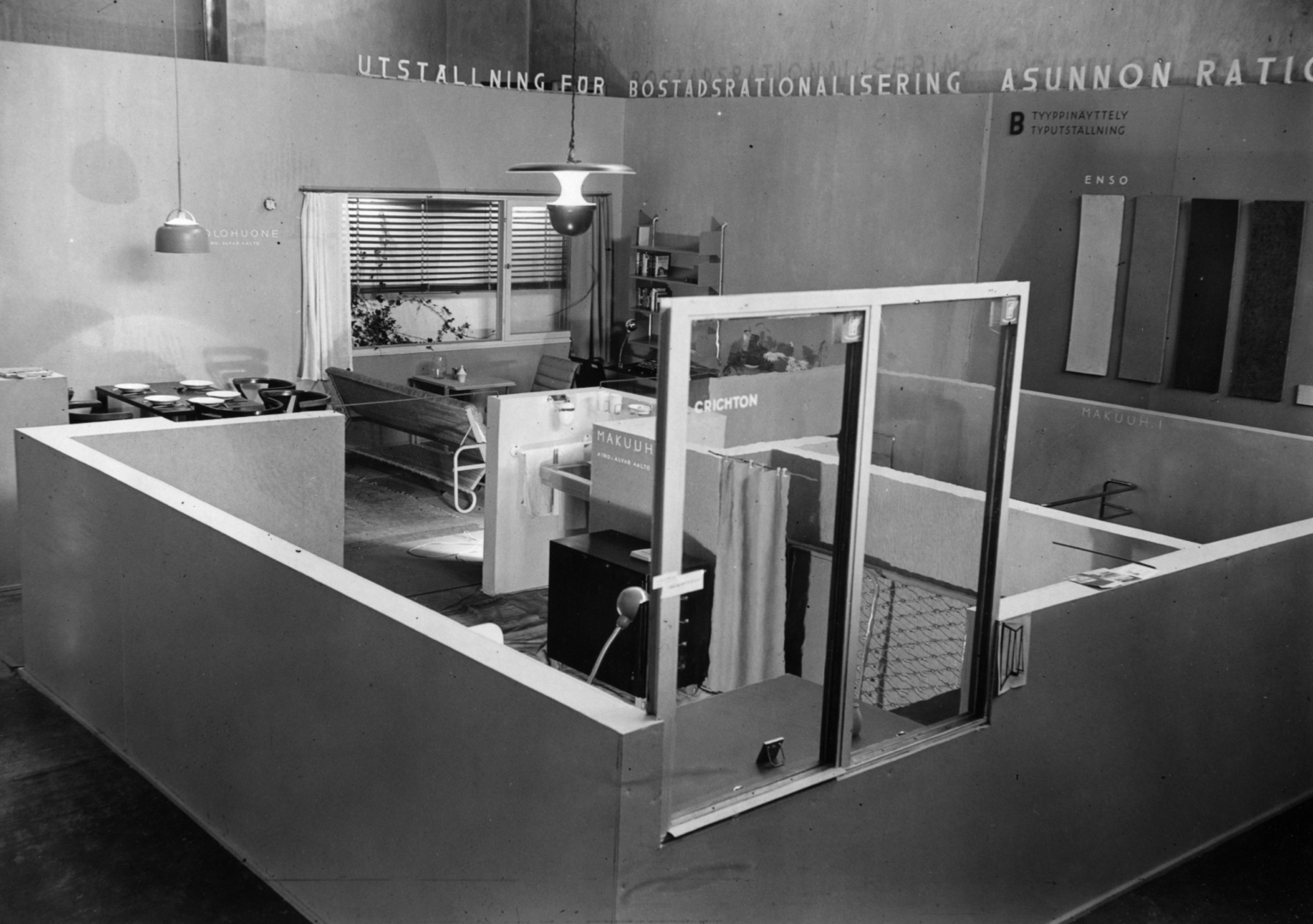
Photograph: Pienasuntonäyttely (The small apartment exhibition), Helsinki Kunsthalle 1930. Photo: Architecture & Design Museum Helsinki.