MAIJA LAVONEN – QUIETLY MONUMENTAL
Maija Lavonen (1931–2023) was an acclaimed pioneer of Finnish textile art. Throughout her long career, she was an avid experimenter who moved effortlessly between diverse materials and techniques. A clothing designer by training, she expanded her repertoire to fabric prints, double cloth weavings and other interior textiles in the late 1960s. She became an independent art practitioner in the late 1970s, at which point ryijy wool pile tapestries emerged as her specialty. One of her innovations was the use of wide, hand-woven ribbons that she joined together to create large-scale spatial pieces from the 1980s onwards. Optical fibre became her principal material in the early 2000s. Central to her work was the dialogue between the texture and structure of textiles and space, with the architectural context and its light often forming the starting point for her artistic process.
Lavonen’s early experiences exerted a lifelong influence on her textile art. She often revisited her childhood memories, especially those associated with nature, above all the sea, forests and meadows. Memories of colours and feelings evoked by nature found distilled expression in her textile art. Handcrafting meant everything to Lavonen – it was in the act of making that her ideas and inspirations found a tangible form.
MAIJA LAVONEN 1931–2023
Maija Lavonen (née Luukela) was born in Olhava village in the municipality of Ii, which lies in the northern province of Oulu. She spent her childhood and youth in Kemi. She studied fashion design at the Institute of Industrial Arts from 1953 to 1956, followed by a year of painting studies at Helsinki’s Free Art School. After her studies, she entered the service of Katinette, a Helsinki-based clothing manufacturer. In 1958 she secured a teaching position at a girls’ vocational school in Karhula.
Maija Luukela married the painter Ahti Lavonen in 1958. The couple exerted a notable formative influence on one other’s artistic philosophies. Together they led a cosmopolitan artist lifestyle in the 1960s, Paris being an especially beloved travel destination. After Ahti Lavonen succumbed to an aggressive illness in 1970, Maija Lavonen became a single mother of two. Art served a therapeutic function during her grieving process, culminating in her first solo exhibition at Kluuvi Gallery in 1970.
A major turning point in Lavonen’s career was her solo exhibition at Turku’s Wäinö Aaltonen Museum in 1978. Following the show’s success, she devoted herself mainly to commissioned projects and solo exhibitions. While working on commissions, Lavonen came up with new ideas that she later adapted and continued developing in her independent projects. Bold experimentation and boundless curiosity were defining features of her practice. Lavonen established herself as one of Finland’s most successful textile artists in the 1980s, and she continued practising art until her death.
CONNECTING THREADS
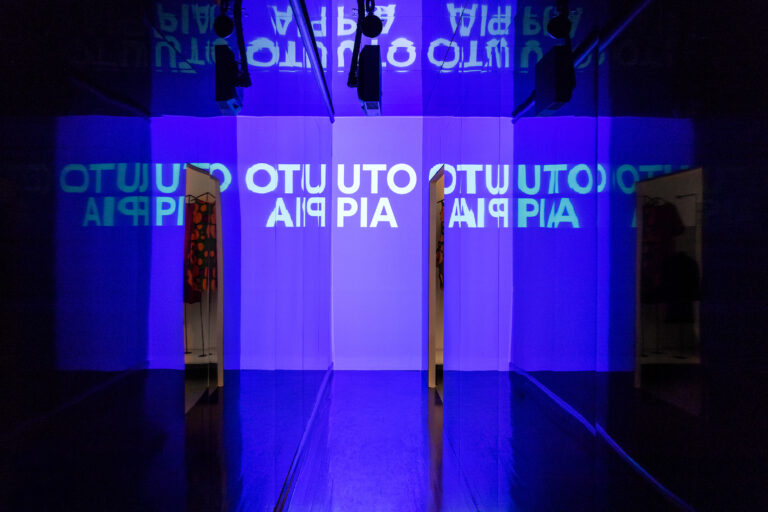
Featured here is a three-part film installation created for this exhibition by architect and video artist Tapio Snellman exploring Maija Lavonen’s multidimensional art interwoven with built and natural environments.
The first part introduces spatial textile pieces commissioned for public institutions that were not possible to include in the exhibition. Four textile works are highlighted in the video. Textile on Three Surfaces (Tekstiili kolmessa tasossa) is a spatial piece displayed in the waiting room of the Speaker’s Office in the Finnish Parliament. Also dating from 1982 is
Nature as the Source (Luonto lähteenä), a commissioned piece found in the lobby of the Ministry of the Interior on Kirkkokatu in Helsinki. Lake Haukivesi (Haukivesi) was completed for Varkaus City Library in 1985, and Scala is a wool pile tapestry commissioned for the Finnish National Opera’s VIP lounge in 1994.
The other two parts take a close look at Lavonen’s conceptual starting points and sources of inspiration. Colours and feelings evoked by nature were always highly important to Lavonen. In the film, Snellman presents her tapestry swatches in natural settings and juxtaposes her watercolour sketches with the tranquil scenery of her birthplace, Sea Lapland. The outdoor footage was filmed in the Hiittinen archipelago in the summer of 2024 in collaboration with architect Ulla Vainikka. The scenery of Sea Lapland was filmed by Juha Niemelä in autumn 2024 and the ryijy wool pile tapestries were photographed by Anni Koponen.
HUMAN TOUCH
The economic boom of the 1980s offered textile artists unprecedented work opportunities through commissions for public spaces and business premises. From the early 1980s onwards, Lavonen’s textile pieces grew noticeably larger. As they grew, they escaped the wall and began spreading into the space around them. Large-scale ryijy wool pile tapestries dominated Lavonen’s oeuvre in the 1980s. Making a wool pile tapestry is time-consuming, as each knot is tied by hand. Lavonen described the labour-intensive process as a way of “storing time” in the artwork, reminding us that human touch is an essential part of the creative process.
The onset of the recession in the early 1990s brought new construction projects and textile art commissions to a standstill. Owing to the high cost of hand-made ryijy production, Lavonen designed relatively few large-scale wool pile tapestries in the 1990s, focusing instead on her independent artistic practice and exhibitions. A steady flow of commissions enabled her to continue staging solo exhibitions regularly.
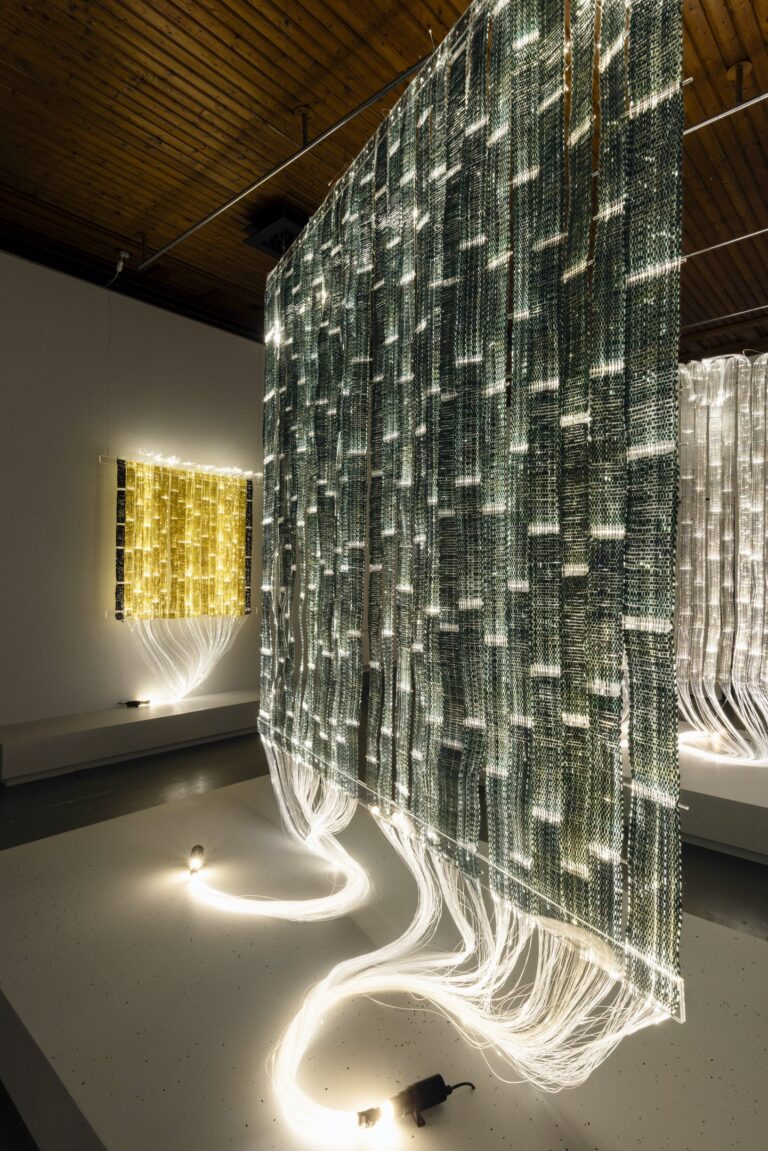
Lavonen constructed many of her large-scale spatial pieces by sewing together wide, hand-woven ribbons of linen, which she then combined with other materials such as steel. She applied the same principle in her fibre optic sculp-tures in the 2000s, in which the warp consisted of optical fibre instead of linen. Ribbon-like elements were woven into this glowing weft illuminated by a light projector.
WEAVER OF LIGHT
It was partly by chance that Lavonen began using optical fibre as her signature material in the 2000s. It all began when she was commissioned to create a textile piece for the staircase of the Ministry of the Interior. As the space was difficult to illuminate, the client wanted the artwork itself to serve as a source of light. Lavonen decided to experiment with a lighting innovation: fibre optics. She hand-wove optical fibres and then transformed them into a light-emitting
fabric with the help of an integrated illuminator. Her fibre optic creations employ the ribbon joining technique she invented in 1978, but with the warp consisting of optical fibre rather than linen, and the weft of linen yarn and acrylic accents.
Valo lähteenä (Light as the Source) was completed for the Ministry of the Interior in 2005. Lavonen’s first encounter with fibre optics led to a long-term fascination with this novel material. Her fibre optic textile art featured in many exhibitions until 2020. Metsän kruunu (Forest Crown) (2010) is the piece she regarded as her proudest achievement with fibre optics.
EXPERIENCING NATURE
Lavonen’s art is invariably rooted in her experiences of nature. The artist described nature as “soothing, healing and revitalizing”. She felt deeply connected to the powerful rhythm of the changing seasons, and derived strength and faith from the certain knowledge that summer would always triumph over the bitter winds of winter.
Natural elements such as sea, stone, cliffs and forest are recurring motifs in Lavonen’s art. Her memories of connecting with nature while living in Kotka from 1958 to 1961 are among the powerful experiences she often revisited in her art, especially the unforgettable sight of the large erratic boulders found on Cape Katariinanniemi. She displayed two works inspired by the landscapes of Kotka at Galleria Sculptor in 1981: the two-part wool pile tapestry Iso kivi (Large Boulder), and a composition of woven linen ribbons joined together to form Kiveä (Stone), a monumental piece evoking a rock surface with its relief-like texture and purple and grey colour scheme.
Lavonen’s experience of nature is often conveyed purely through colour. The atmosphere of autumn in Lapland is captured in vibrant hues of red and orange. Kevät (Spring) depicts patches of black earth emerging from receding snow with the promise of new growth.
REVISITED MEMORIES
Lavonen grew up on the Bothnian Bay, spending her early childhood in Olhava village in the municipality of Ii, and later moving to Kemi. Her memories of the Northern landscape, especially the sea and horizon, or more precisely the feelings they evoked, became an enduring source of inspiration for her art. Many of her compositions portray a horizon between sea and sky. Lavonen painted her first minimalistic horizon compositions in her sketchbook in 1977. Horizons remained a recurring motif in her art until the 2000s.
Memories and feelings evoked by Kemi’s seascapes are the subject of the wool pile tapestries and laminated silkscreen prints that Lavonen presented in her 1978 solo exhibition at the Wäinö Aaltonen Museum in Turku. Many wool pile tapestries in the exhibition were square-shaped and minimalistic, their nuanced grey palette evoking the cold gloom of the northern sea, while at the same time delivering a glimmer of hope.
Lavonen continued exploring sea horizons in her linen ribbon pieces from 1980 and 1981, some of which leapt from the wall and spread across the floor and interior.