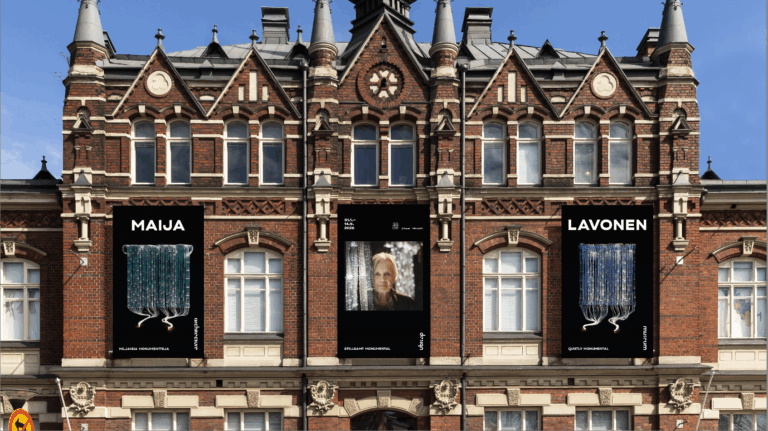
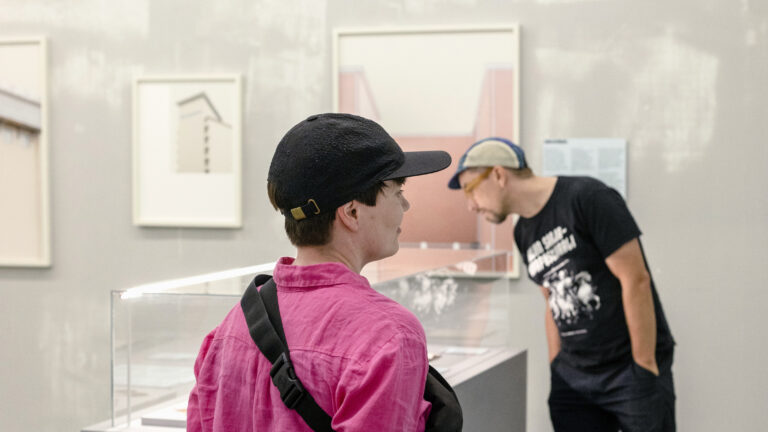
You can find the accessibility information for the Aalto Design – Shapes of Wellbeing exhibition on this page. The information provides details about the exhibition’s accessibility and accessibility features.
Accessibility Information
Floor Plan and Sensory Map
The Aalto Design – Shapes of Wellbeing exhibition is divided into five larger and three smaller gallery rooms, which together form a corridor. There is no separate guide map or printed floor plan available to borrow during the museum visit.
A floor plan and a sensory map of the exhibition space are available on this website. The floor plan shows the exhibition from above on the museum’s first floor. The sensory map provides information about the exhibition’s sensory experience.
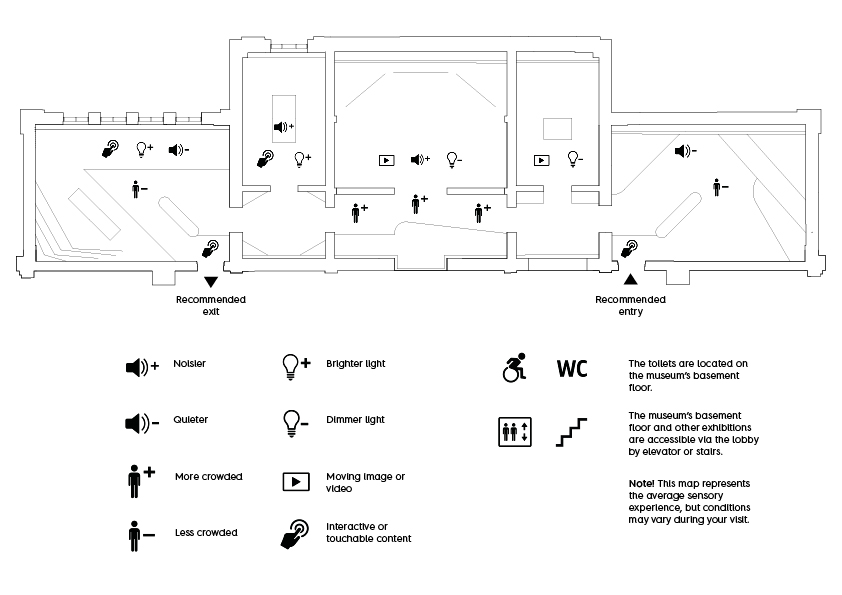
Aalto Design – Shapes of Wellbeing exhibition floor plan and sensory map.
Exhibition Overview and Contents
Located on the museum’s first floor, Aalto Design – Shapes of Wellbeing explores the legacy of Alvar, Aino and Elissa Aalto from the perspective of wellbeing. This multidisciplinary exhibition opens up discussion on the relevance of classic designs in contemporary wellbeing design.
The exhibition includes a wide range of content, such as drawings, photographs, videos, scale models, objects, furniture and books. In total, the exhibition features 27 glass objects, five reliefs, five scale models, 13 drawings, 46 photographs, 21 objects or pieces of furniture, and two brick samples. In addition, there are two large multi-channel video installations. The exhibition also includes an activity space and the Aalto Lounge, where books, objects and furniture are on display.
Please do not touch the contents unless otherwise indicated, as the materials are sensitive to dirt and damage.
Exhibition Texts and Linguistic Accessibility
Exhibition texts are presented in font sizes of 37, 48, or 64 points. They are displayed on walls, in display cases, and on plinths, primarily in black sans-serif type on a white background.
The texts are available in Finnish, Swedish and English. Easy-Finnish versions of the exhibition texts are compiled in a separate booklet, which can be borrowed at the exhibition entrance for the duration of your visit.
Handheld booklets printed in large type (15 pt) in Finnish, Swedish and English are also available at the entrances and can be borrowed during your visit. All exhibition texts are also available online.
The video works in the exhibition are subtitled in Finnish, Swedish and English.
Sensory Environment and Multisensory Experience
Visual Appearance and Lighting
The exhibition’s visual design is white, bright and fresh. Lighting is generally strong. Both spotlights and natural light are used in the space. Rooms containing video or moving images are dimmer. Illuminated magnifying glasses and flashlights can be borrowed from the museum’s customer service desk.
Lighting levels vary depending on the space and weather conditions:
- Objects and artworks: approximately 200–600 lux
- Exhibition texts: approximately 100–200 lux
- Scale models: approximately 200 lux
- Display cases: approximately 600 lux
- Interactive space and Aalto Lounge (table surfaces): approximately 500–600 lux
In the activity space, the lighting on table surfaces can be adjusted to suit individual needs.
Moving Image and Soundscape
The soundscape of the exhibition is occasionally noisy. During busy times, echoes may occur. Areas that are relatively louder or quieter are indicated on the sensory map.
The exhibition includes two large video installations featuring moving images. The videos and image presentations cannot be paused. The audio from one of the video installations can be heard throughout the exhibition space. The soundtrack consists primarily of spoken Finnish and English, as well as ambient music. The video content has a duration of approximately 60 minutes. All other artworks containing moving images are silent.
Acoustics vary between rooms. Guided tours use a microphone when needed, and visitors may request that the guide use one.
Interaction and Tactile Elements
The activity space contains tactile materials (glass, ceramics, wood) that museum visitors can use for building. Instructions and reflective tasks are available to support this activity. Materials must be handled carefully and calmly. They may release dust and small fragments. This activity is not recommended for very young children.
The interactive space also includes learning materials for teaching groups and Easy-Finnish materials for groups practicing Finnish.
The Aalto Lounge offers freely usable furniture and books that museum visitors can read and browse. The materials used in the furniture are primarily wood, leather and various textiles.
Structure of the Exhibition Space and Routes
The museum’s first-floor exhibition space consists of three smaller exhibition rooms forming a corridor, as well as five larger exhibition rooms located along and at the ends of the corridor. The exhibition space can be accessed from the museum lobby through the larger exhibition rooms at either end of the corridor. The recommended entrance is the one on the right when viewed from the customer service desk. This entrance is marked on the floor plan on the website.
The walls of the exhibition spaces are white, and the floors are medium grey. The entrances consist of wooden double doors opening into the lobby, which remain open during the museum’s opening hours. The doorways are approximately 122–125 cm wide. The doorways have thresholds that are not beveled. These are approximately 2–4 cm high.
There are no opening doors within the exhibition space. The doorways are approximately 120–130 cm wide. The doorways have no thresholds, with one exception. This threshold is approximately 3 cm high and has been beveled with a wooden threshold ramp. The exhibition space has wooden flooring which is partly uneven, with areas of wear such as dents, grooves, and raised sections that have been partially smoothed.
The space includes plinths, display cases, partitions, and seating that structure the exhibition area. Artworks and labels are placed on walls, in display cases, and on plinths. The height of the display cases and plinths ranges from approximately 30 cm to 95 cm. The exhibition includes four glass display cases, each approximately 2.5 m high. The hanging height of artworks and artwork labels ranges from approximately 30 cm to 3 m. The placement of structures has been designed to minimize the risk of collision; however, there are also sharp corners and elements that may not be detectable, for example, with a white cane.
The circulation routes in the exhibition space are wide and clear. There is sufficient space for moving and turning, for example with a wheelchair or a stroller. However, during busy times the space may feel crowded. In the functional space and in the Aalto Lounge, there is approximately 90 cm of space around tables during use.
Seating and Rest Areas
Foldable portable seats with armrests are available at the main entrance to the exhibition and in the exhibition space. The seats weigh 1.7 kg. Their seat height is 53 cm, width 40 cm and depth 24 cm.
The wooden armchairs located by the second video installation have a seat height of 39.5 cm, a width of 52 cm and a depth of 60 cm. The chairs have backrests and armrests.
The seating in the activity space consists of wooden stools and chairs. Their seat height is 43 cm, and the seat diameter is approximately 35 cm. The stools do not have backrests or armrests. The chairs have both backrests and armrests.
A movable step stool is available in the activity space and can be used as a platform for viewing exhibition content. The step stool is 14.5 cm high.
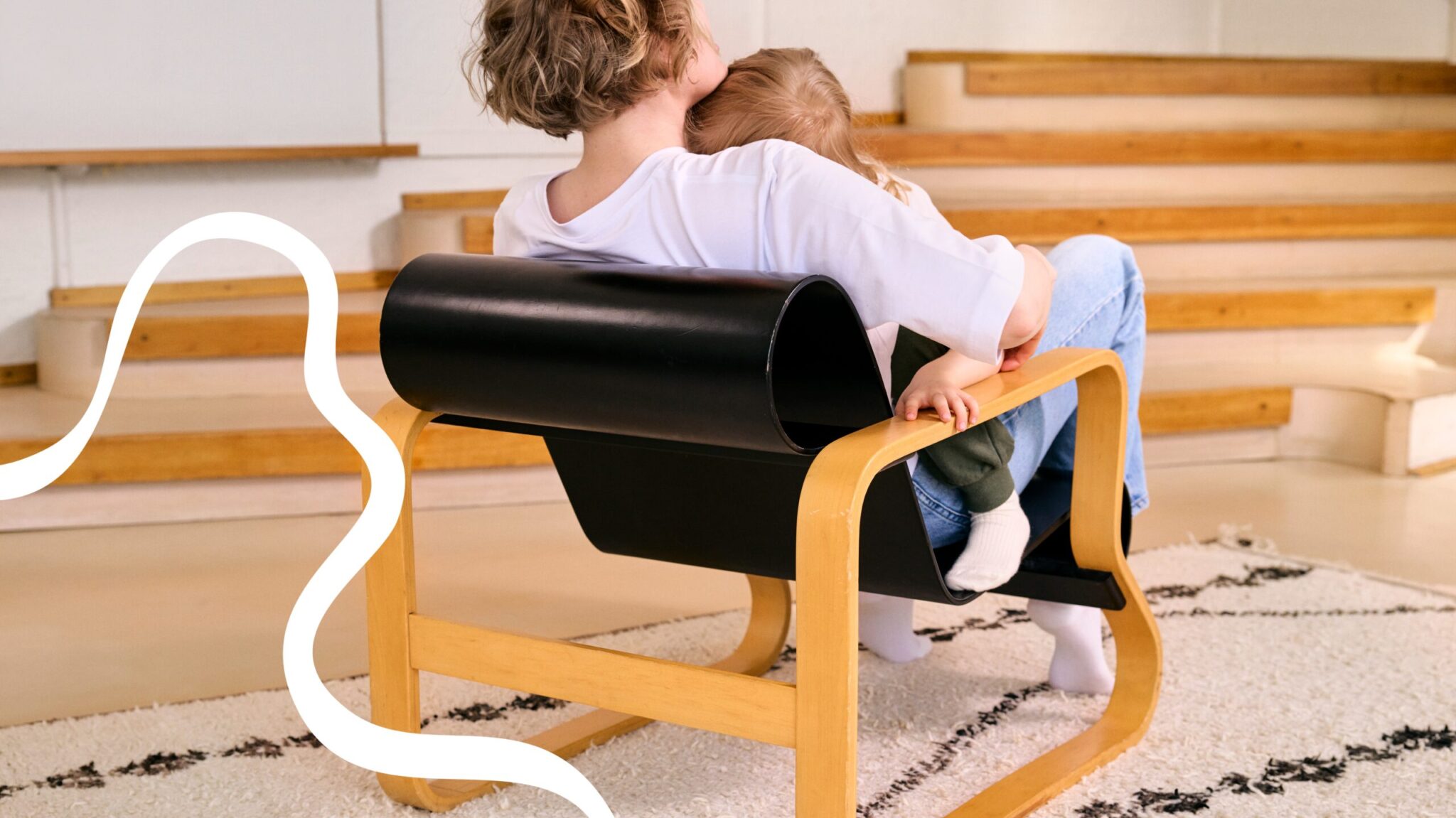
In addition, Aalto Lounge contains a variety of stools, armchairs and chairs with different seat heights. Some of the seats have backrests and armrests.
Aalto Lounge offers space for rest and relaxation, both alone and together with others.